The Inspection Report That Never Closed
A line on an inspection report read: deficiency noted, corrective action required. A grounding connection on a new substation was not to spec. The crew fixed it the following Tuesday. Someone re-inspected it, nodded, and moved on. The work was good. The work was, in fact, never the problem.
The problem surfaced two years later, when a regulator pulled the file. They were not questioning the substation's safety; they were questioning the record. The closing re-inspection - the single page that turns 'corrective action required' into 'corrective action verified and closed' - was not there. No one could say where it went. Maybe it was a photo on a phone that got replaced. Maybe it was a form the inspector filled out and meant to scan. What everyone knew for certain was that the fix happened. What nobody could prove was that it happened.
An open item is a promise the file never kept
Every inspection deficiency is a small open loop. It opens the moment it is flagged and it is supposed to close the moment the fix is verified and recorded. In a healthy project, those two events happen days apart and the closing record lands in the file beside the original flag. In the real world, the gap between the work being done and the work being provable can stretch into years - and the longer it stretches, the more likely the closing record simply evaporates.
The reason this slips is structural, not careless. The person who flags the deficiency, the crew who corrects it, and the inspector who verifies it are often three different parties on three different schedules. By the time the fix is verified, the contractor may have demobilized, the inspector may have rotated to another site, and the original report is buried under a hundred newer ones. The correction is real. The handoff that was supposed to capture it never completed.
Here is the uncomfortable part: an item that was fixed but never closed on paper looks identical, in an audit, to an item that was never fixed at all. The regulator cannot see your good intentions. They can only see whether the record closes the loop.
Watch the gap, not just the list
Most teams track flagged items. Far fewer track the distance between three numbers: how many items were flagged, how many were actually corrected, and how many have a closure record sitting in the file. On a typical project those three numbers should be nearly identical. When they diverge, the gap is your exposure - work you have done but cannot defend.
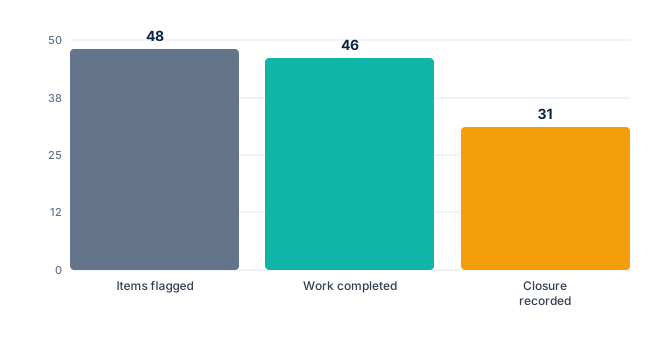
That third bar - closure recorded - is the one that protects you. The first two are about doing the work. The third is about being able to prove you did it, on a day, years from now, when you are not in the room to explain.
Close the loop the same week you open it
Give every flagged deficiency a unique number and an owner the moment it is raised.
Treat the closure record - the verified re-inspection, signed and dated - as the only thing that moves an item to 'closed'. A verbal 'it's handled' does not close it.
Run a standing review of open items every month. Anything open longer than its target window gets escalated before it ages out of memory.
Store the closing record beside the original flag, not in a separate inbox, so the loop is visible as one thing.
None of this is exotic. It is the discipline of refusing to let an item be 'done in the field but open on paper.' The morning after an inspection is when the closing record is easiest to capture - a folder is open and a crew is still on site. Two years later, when the regulator calls, it is the hardest thing in the world to recreate.
The pattern repeats anywhere a fix and its proof get separated by time - and once you start looking, you see it everywhere. More field notes on records that catch the money walk through the same trap on construction sites, capital budgets, and land deals.