One Chart: Where Project Budgets Quietly Leak

When a capital project runs over, the postmortem usually goes hunting for the villain - the one bad estimate, the one vendor, the one decision. It is a comforting story because it implies an easy fix. It is also, most of the time, wrong. Overruns are rarely a single failure. They are an accumulation of small, undocumented leaks, each one too minor to alarm anyone, that add up to a number large enough to end careers.
The reason they stay hidden is that none of them appear cleanly on a budget summary. The summary shows you a category over its line. It does not show you that the overage is three weeks of a crew waiting on an approval, plus a rework loop caused by a drawing nobody knew was superseded, plus two change orders that were done but never billed. The summary shows the symptom. The leaks are the cause, and the cause is almost always a records problem wearing a budget costume.
The leaks you can't see on the summary
Break a typical overrun into its real components and the same handful of culprits show up, in roughly this order of size:
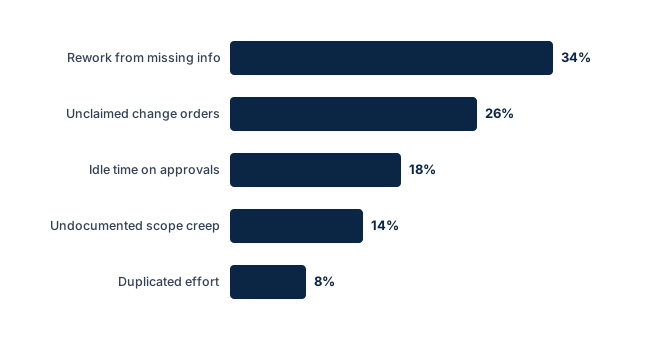
Look at what dominates. The biggest slice is rework from missing or stale information - work redone because the right document was not in the right hands at the right time. The next is unclaimed change orders - real work, never billed. Then idle time waiting on approvals that sat in someone's queue. Then scope that crept in without being documented or priced. Then plain duplicated effort, two people solving the same problem because neither knew the other had.
Notice what every one of these has in common. Not one of them is a market force or an act of God. Every single leak is a record that was missing, late, lost, or never written. The overrun is not really a cost problem. It is an information problem that converts itself into a cost problem, quietly, one small leak at a time.
How to find your leaks before they pool
You cannot fix what you cannot see, so the first move is to stop accepting category-level overages as explanations and start asking what the overage is made of. A few habits surface the leaks early:
Tag rework when it happens and record why - missing info, superseded drawing, late approval - so the pattern becomes visible instead of vanishing into 'labor.'
Keep a live change-order log with an unbilled column, so completed-but-uninvoiced work cannot hide.
Track approval cycle time; idle days waiting are a cost even when no one is invoicing for them.
Make 'where did this number come from' a question the project can always answer in minutes, not days.
The overrun you are afraid of is not waiting in some big future decision. It is leaking, right now, in small undocumented places. Find the leaks while they are still drops, and the dramatic number on the summary never gets the chance to form.
Every one of these leaks traces back to a record that was missing when it mattered. See the rest of this week's field notes on records that catch the money for the same lesson on inspections, change orders, and the price of lost information.