The Cost of Lost Information Is a Number - Here's How to Find It

Ask a leadership team what poor information costs them and you will usually get a shrug and a phrase: 'It's hard to quantify.' That phrase is the most expensive sentence in the room, because anything you decide is unmeasurable is something you have quietly decided not to manage. The truth is the opposite. The cost of lost, late, and unfindable information is not a vibe. It is a number - and you can find it with arithmetic you already have the inputs for.
The reason it feels invisible is that it never arrives as a single bill. It hides inside other line items: labor, overtime, legal, schedule. Pulled apart, though, the cost of poor information lives in four buckets, and you can put a real figure on each one without a consultant or a study.
A simple way to price your records risk
Time spent searching. Roughly how many hours a week do your people spend looking for documents, versions, or approvals that should be findable in seconds? Multiply by loaded hourly cost. For most teams this single bucket is larger than they expect, because searching feels like working.
Rework on stale information. How often is work redone because someone built on a superseded drawing, an old number, or a decision that had already changed? Each instance has a cost in hours and materials. Tag a few and extrapolate.
Disputes and claims. What do you spend defending or settling positions you could have proven instantly with a clean record - change-order disputes, audit findings, contract arguments? The legal and settlement cost of being unable to prove what you already did.
Schedule delay. When a decision waits on information nobody can find, the whole project idles. Put your daily cost of delay against the days lost to missing information, and this bucket often dwarfs the rest.
Add the four and you have a number - your annual cost of poor information. It will not be exact, and it does not need to be. A defensible estimate changes the conversation entirely, because now the problem has a size, and a problem with a size can be compared against the cost of fixing it.
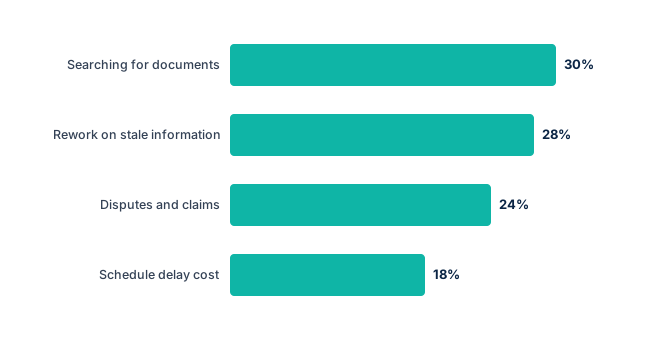
Look at the shape. No single bucket is the whole story; the cost is broad and distributed, which is exactly why it stays invisible. Each piece is small enough to dismiss in isolation and large enough to matter in sum. That is the signature of every expensive problem nobody is managing.
Price it, then shrink it
Once the number exists, the path forward is obvious. You do not need a transformation program; you need to make information findable, current, and provable - one source of truth instead of a scatter of inboxes and drives. That is the entire premise behind XNM-VISION: put the project and its records in one place where the right version is always the one you find. But the framework above costs nothing, and running it yourself is the honest first step - because you cannot manage a number you have refused to calculate.
This number is the sum of all the smaller leaks - the open inspection, the unbilled change, the budget that drifted. Read this week's field notes on the records behind each one and watch the abstract 'cost of poor information' resolve into specific, fixable habits.