The $51-Billion Wave Hits the Tender Box: Why Municipal Procurement Is a Records Discipline
A wave of federal money is heading for the places that build closest to the ground. In April 2026 Ottawa launched the Build Communities Strong Fund - $51 billion over ten years - aimed squarely at the transit lines, water systems, recreation centres, fire halls and broadband that municipalities own and operate. For a finance director or a purchasing manager, the headline is the opportunity. The quieter truth is that none of that money turns into a finished project without passing through a procurement process - and the defensibility of every award lives or dies in the record behind it.
Municipal procurement is where public money meets public scrutiny. A single capital tender generates a thick, time-sensitive record: the scope and drawings that went out, the addenda that changed them, the questions bidders asked, the bids received, the evaluation that scored them, the award decision and its rationale, the signed contract, and every change order after. When that record is complete and instantly producible, an award stands up to an unsuccessful bidder's challenge, an auditor's review, or an integrity commissioner's inquiry. When it is scattered across inboxes, a procurement officer's desktop, and a consultant's server, the same award becomes a liability - not because anything was done wrong, but because the municipality cannot prove it wasn't.
Recent context
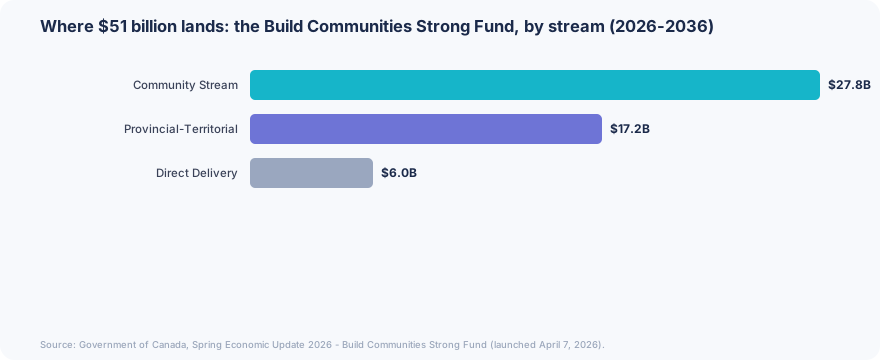
The money is real and dated. The Government of Canada's Spring Economic Update 2026 confirms the Build Communities Strong Fund as a $51-billion, ten-year investment, launched April 7, 2026, with $27.8 billion flowing through a Community Stream for public transit, recreation facilities, fire halls and broadband, $17.2 billion through a provincial-territorial stream for housing-enabling, education and health infrastructure, and $6.0 billion for direct-delivery projects. The capital reaches municipalities through bilateral agreements - which means the spending, and the records that justify it, land squarely on local desks.
An award is only as defensible as its file
It is tempting to treat procurement paperwork as the friction around the real work of building. It is the opposite: in public capital projects the procurement record is the work's legal spine. Trade-agreement obligations, municipal purchasing by-laws, and the simple expectation of open and fair competition all assume that a municipality can show, after the fact, exactly what it asked for, who responded, how bids were scored, and why the winner won. The hardest cases are the routine ones - the sole-source justification buried in a staff report, the addendum some bidders saw late, the evaluation notes no one wrote down. None of these is misconduct, but each becomes a question the file has to answer. A $51-billion build-out multiplies the number of those moments by every community that draws on the fund.
How XNM helps
XNM helps municipalities run the whole procurement and capital-project record from one auditable command centre - the solicitation and its drawings, addenda, bid submissions, evaluation scoring, the award and its rationale, the contract, and every change order, tied to the project and kept current. Where it helps, the XNM-Vision platform lets a purchasing manager or finance director produce the complete file for any award on demand - the version that went out, the questions and answers, who scored what - so a challenge or audit meets a record rather than a reconstruction. Because it stands up in days rather than the many months a records overhaul usually takes, the discipline is in place before the first fund-backed tender closes, not after the first dispute.
Practical takeaways
Treat the procurement file as the award's defence. An award you cannot document is one you cannot defend; build the record as the tender runs, not after a challenge lands.
Keep the whole chain, not just the contract. Scope, addenda, bidder questions, evaluation notes and change orders are the evidence - the signed contract alone does not explain why this bidder won.
Make sole-source decisions self-justifying. Non-competitive awards draw the most scrutiny; keep the justification in the procurement record, not buried in a staff report no one can find later.
Tie every award to its project and budget. A fund-backed grant will ask what was procured and what it cost; keep procurement, contract and spend in one place so the answer is one query, not a week of digging.
Assume a challenge or audit on every major tender. Unsuccessful bidders, auditors and integrity commissioners all read the same file; keep it complete and time-stamped so it answers them in your favour.
FAQ
We post tenders on a procurement portal. Isn't that the record?
A portal handles the going-out and the bids coming in, but the defensible record is wider than that: the evaluation scoring, the award rationale, the contract, and the change orders that follow live outside most posting platforms. The gap between 'the tender was posted' and 'we can show exactly how and why we awarded it' is where challenges are won and lost - and that gap is the part a portal does not close.
Isn't this just more administrative burden on a small team?
It is less burden, not more - just moved earlier. The real burden is reconstructing a procurement file under deadline after a bidder complaint or an audit request, from memory and scattered email. Capturing the record as the tender runs turns that fire drill into a single retrieval, which is exactly what a lean municipal team needs when the fund-backed work arrives all at once.
The bottom line
A $51-billion fund is a generational chance for communities to build - and a generational test of whether they can account for how they spent. The municipalities that come through it cleanly will not be the ones with the most staff; they will be the ones whose procurement record could answer any question on any award, the day it was asked. The money lands in the tender box, but the award is decided in the file.