Planted Once, Owed for Decades: Why Reforestation Is a Records Obligation, Not a One-Time Job
Somewhere in British Columbia this summer, a forester will walk a five-year-old cutblock with a tablet, counting healthy seedlings per hectare to judge whether the stand is finally on its way to 'free growing.' That walk is the visible tip of an obligation that began the day the trees came down and will not be discharged for a decade or more. Reforestation is not an event at the end of a harvest. It is a multi-year promise - and like every promise a regulator can audit, it lives or dies on the record behind it.
Across Canada, the company that harvests a stand - or whose tenure burns before the new forest matures - is legally on the hook to bring that ground back to a free-growing condition. Meeting that duty is not one planting season; it is site preparation, planting, brushing, and a sequence of surveys - regeneration delay, stocking, and finally free growing - each one a dated, defensible measurement that must be filed against the right opening on the right tenure. Multiply that by every block across a working forest and several active fire years, and a woodlands group is carrying thousands of open obligations at once, each on its own clock. The forest is real; so is the paperwork that proves you kept your word.
Recent context
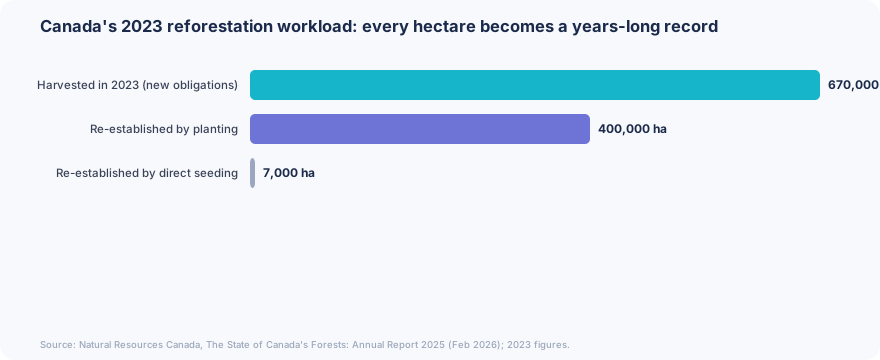
The scale shows up in the national numbers. Natural Resources Canada reported in February 2026 that in 2023 Canadian operators harvested nearly 670,000 hectares - about 0.2% of the country's forest - and planted 563 million seedlings on some 400,000 hectares, with regeneration treated as 'a key requirement following any harvest operation on public lands.' Every one of those hectares opens a years-long obligation that someone has to track to completion. The country runs national inventories and forestry databases precisely because the duty does not end when the planting crew leaves.
Why reforestation is a records discipline
It is tempting to file silviculture under field work and leave it there. But the duty a regulator actually enforces is documentary: not 'did you plant,' but 'can you show this opening met regeneration delay, then stocking, then free growing, on these dates, by these surveys, to this standard.' The clock runs for years - often well over a decade - and the obligation outlives staff, contractors, and reorganizations. When the survey data, the planting records, the maps, and the declarations live in separate systems - a GIS layer here, a contractor's spreadsheet there, a PDF survey in someone's inbox - a company cannot see, at a glance, which of its thousands of open blocks are on track and which are quietly slipping toward a missed free-growing deadline. The exposure is not abstract: a block that misses its window is a compliance finding and a cost the company still owes.
The pressure is rising. A May 2026 Forests Canada study of 80 forest managers found that as wildfire reshapes the landscape and natural regeneration becomes less reliable, more ground needs deliberate replanting and longer monitoring - exactly the conditions under which a thin or scattered record turns a manageable obligation into an unprovable one.
How XNM helps
XNM helps forestry organizations pull the whole reforestation obligation into one auditable record - openings and their boundaries, planting and treatment history, every survey and its result, and the free-growing declarations that finally close each block - tied to the tenure and kept current. Where it helps, the XNM-Vision platform gives a woodlands manager a single line of sight across every open obligation: what is due, what is overdue, and what is one survey away from being discharged. When a compliance review, a tenure transfer, or a certification audit asks for proof that the forest was re-established, the evidence is already assembled and dated rather than reconstructed from a retiring forester's memory. And because it stands up in days rather than the long rollout a records overhaul usually demands, the visibility arrives before the next planting season, not after the deadline has passed.
Practical takeaways
Treat the free-growing obligation as an open file, not a finished job. The duty runs for years after the planting crew leaves; track every block to its declaration, or it quietly becomes a liability.
Keep surveys, maps, and planting records together. Regeneration delay, stocking, and free-growing surveys only protect you if they sit with the right opening - not scattered across GIS, spreadsheets, and inboxes.
Watch the clock on every opening. Thousands of blocks on individual timelines means the real risk is a deadline you never saw coming; a single view of what is due and overdue is the whole game.
Make the record survive turnover. Foresters retire and contractors change; the obligation does not. Proof of re-establishment has to belong to the organization, not to one person.
Assume the obligation will be audited or transferred. Compliance reviews, certification, and tenure deals all test the record; keep it assembled and dated so the answer is ready before the question.
FAQ
We already plant everything we harvest. Isn't the obligation met?
Planting starts the obligation; it does not discharge it. The duty is to establish a free-growing stand, and that is proven by surveys over years - regeneration delay, stocking, and finally free growing. A block can be planted and still fail to reach free growing because of competition, browse, or drought. The record of what was measured, when, and to what standard is what actually closes the file.
Our survey data lives in a GIS. Isn't that enough?
A GIS tells you where; it rarely tells you the full obligation story - the planting history, the contractor records, the dated survey results, and the declaration that finally satisfied the duty for that opening. The failures happen in the seams between systems. Keeping the whole obligation in one current record is what lets you see, across the entire tenure, which blocks are on track and which are slipping.
The bottom line
A re-established forest is a promise kept, and a regulator's question is always the same: prove it. The companies that meet their silviculture obligations without drama are not the ones that plant the most trees in a season; they are the ones whose record can show every open block on its way to free growing, on time and on the books. Reforestation is owed for decades, and the record is how you stay good for it.