When the Audit Letter Comes, Your Books Are the Defence: Trust Records in a Law Firm

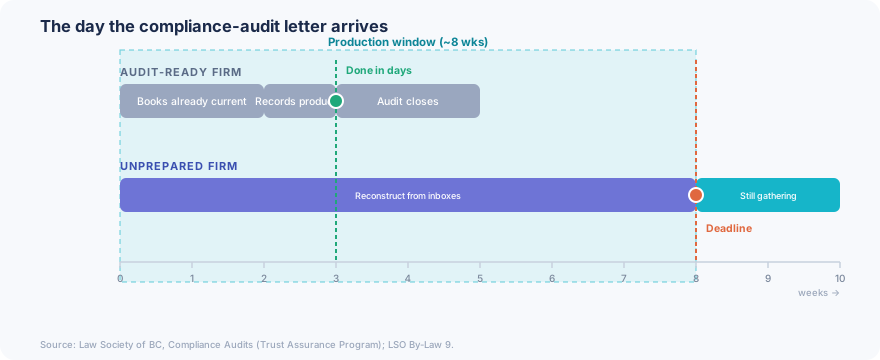
The envelope from the law society does not announce itself. One morning a managing partner opens a letter saying the firm has been selected for a compliance audit, and the clock starts: the trust ledgers and the most recent reconciliation are due within a week or two, the full books-and-records package within roughly two months. For a firm whose records are current, this is an inconvenience. For one whose trust accounting has been 'mostly fine,' it is the start of a bad season - because the audit does not test whether the money is safe so much as whether you can prove it.
Every Canadian law society polices the same bargain: a firm may hold client money in trust, and in exchange it must keep that money provably separate and account for it to the penny, on a fixed cadence, in a form a regulator can inspect on demand. That means client trust ledgers, monthly reconciliations, transfer records, and the supporting documents behind every movement - maintained continuously, not assembled when the letter arrives. The trap is that the books can be accurate and the firm can still fail, because the test is producibility. A reconciliation that was done but never recorded, a ledger that lives in one bookkeeper's spreadsheet, a month that was 'caught up later' - each is a finding waiting to happen, regardless of whether a dollar was ever at risk.
Recent context
The expectations are explicit. The Law Society of British Columbia's compliance-audit program checks that trust funds were used only for proper purposes and that the firm's records meet the rules - and it requires the client trust ledgers and the latest trust reconciliation up front, with the complete records package to follow, typically within six to eight weeks. Audits are largely random, but late trust reports, signs of non-compliance, and prior deficiencies all raise the odds. Failure to produce the records is itself grounds for administrative suspension - the file, not the firm's good intentions, is what is on trial.
Producibility is the standard, not accuracy
Most trust-compliance trouble is not theft; it is bookkeeping that drifted. A reconciliation completed late, a ledger that does not tie to the bank, a client balance that was right but never written down - the Law Society of Ontario, for instance, requires monthly reconciliations completed within 25 days of the statement period, and a single missed deadline or recording error can trigger an audit even when every balance is correct. The firms that sail through are not the ones with the most careful intentions; they are the ones whose books were already current the day the letter came, because the only thing an audit measures is what you can put on the table now.
And the stakes are rising. The Federation of Law Societies of Canada's July 2025 effectiveness report set out how law societies monitor trust accounting and discipline its misuse - suspensions, revocations, and limitations on trust accounts among them - as Canada's anti-money-laundering regime faces its own international review. Trust records are no longer just an internal housekeeping matter; they are the evidence a regulator uses to judge whether a firm should keep handling client money at all.
How XNM helps
XNM helps law firms keep the trust and matter record in one auditable system - client trust ledgers, monthly reconciliations, transfer authorizations, and the documents behind each entry, organized by matter and kept current. Where it helps, XNM-Vision makes the firm's books continuously producible: the reconciliation that was done is recorded and findable, the ledger ties to the matter, and the complete package a compliance audit asks for can be assembled in an afternoon instead of a frantic month. The aim is not to replace the bookkeeper or the accounting system; it is to ensure the record that protects the firm's licence is whole, current, and ready - so an audit letter is a routine request, not an emergency. And it stands up in days, not the long projects records clean-ups usually become.
Practical takeaways
Keep the books continuously producible, not just accurate. An audit tests what you can hand over today; a reconciliation that was done but never recorded counts for nothing when the letter arrives.
Reconcile on the regulator's clock, every period. Monthly reconciliation within the deadline is the single discipline most likely to keep you off the audit list - and most likely to clear you fast if you land on it.
Tie every trust movement to its supporting document. A transfer without a record behind it is a finding; keep the authorization and the reason filed with the entry, not in someone's memory.
Do not let the trust record live in one person's spreadsheet. If the bookkeeper is the only one who can produce the books, the firm's licence depends on their availability - make the record the firm's, not theirs.
Treat an audit as a certainty, not a risk. Selection is largely random; the only defence is a file that is always ready, so build the record as you go rather than reconstructing it under a deadline.
FAQ
Our trust account always balances. Why would we fail an audit?
Because an audit tests records, not just balances. The Law Society of Ontario is explicit that a missed reconciliation deadline or a recording error can trigger and sustain a finding even when the money is entirely accounted for. Accuracy is necessary but not sufficient; the obligation is to keep contemporaneous, producible records - and the firms that stumble are usually the ones whose books were right but late, informal, or trapped in a format no one could produce on short notice.
Isn't this just the bookkeeper's job?
The bookkeeping is theirs; the exposure is the firm's. When the only complete copy of the trust record lives in one person's system, the firm's standing depends on that person being available and that system being intact. A governed record that the firm owns - current, reconciled, and producible by more than one hand - is what turns a compliance audit from a scramble into a routine request.
The bottom line
For a law firm, the trust ledger is both the proof that client money is safe and the firm's defence when a regulator asks. Five minutes of doubt about whether the books are current is five minutes too many when the audit letter is already on the desk. The firms that hold their standing are not the ones with the cleverest practice-management software; they are the ones whose record was never in question. Trust accounting is not a bookkeeping chore. It is how a firm keeps the right to hold its clients' money.