The Change-Order Log That Pays for Itself

Halfway through a build, a project manager could not answer a simple question: had change order fourteen ever been approved, and had it ever been billed? The client remembered asking for the change. The crew remembered doing it. Somewhere between a hallway conversation and a busy Friday, the paperwork had gone soft. That one uncertainty, multiplied across a job with forty changes, is where a contractor's margin quietly leaves the building.
Changes are not the problem. Every real project grows and shifts; clients ask, conditions surprise you, the design evolves. The problem is the gap between doing extra work and being provably owed for it. Close that gap and changes are just business. Leave it open and every change is a small bet that everyone will remember the deal the same way months later. They will not.
The log is the cheapest insurance on the job
A change-order log is not bureaucracy. It is the single most cost-effective document on a construction project, because it converts fuzzy memory into a defensible position before anyone needs to argue. It does not have to be elaborate. It has to be consistent, and it has to be one list - not three half-lists in three people's inboxes.
Every change, the moment it is requested, earns a row. A good row carries:
A unique number and date. so the change can be referenced unambiguously by everyone.
Who requested it and a one-line description. enough to reconstruct the scope without a meeting.
The cost and schedule impact. priced when memory is fresh, not reconstructed at closeout.
Approval status and how it was approved. a signature, an email, a meeting minute - the proof, attached.
Invoiced status. the column that quietly tells you which completed work has not yet been billed.
That last column is the one that pays for the whole log. It is a running list of money you have earned but not yet collected. Without it, unbilled changes do not announce themselves - they simply never get invoiced, and the loss is invisible because you never see the number that should have been there.
What discipline actually recovers
Picture a job with roughly a hundred thousand dollars of client-directed changes. With no real log, a contractor recovers what they can defend - which, after the disputes and the forgotten ones, is a fraction. With notes scattered across emails, they do better but still leave money behind. With one disciplined log, nearly all of it is provable and billable. The work was identical in all three cases. The only variable was the record.
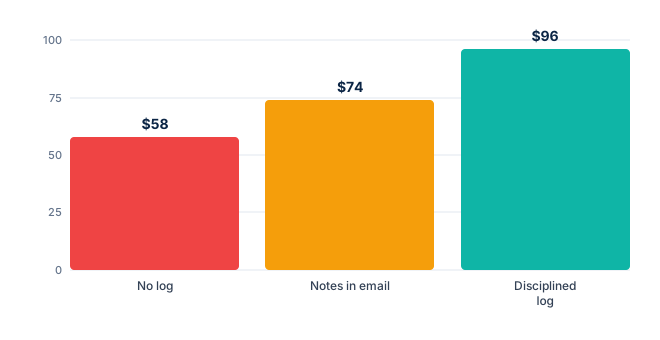
The difference between the first bar and the last is not effort in the field. It is a habit at the desk. The crew built the same building. One contractor got paid for all of it.
Start the log before you need it
The log only works if it exists before the first dispute, because its whole power is being contemporaneous - written when the change happened, not reconstructed when the money is contested. Open it on day one, give one person the job of keeping it current, and review the unbilled column at every progress meeting. This is exactly the kind of single, shared, always-current record that XNM-VISION exists to keep honest - but even on a spreadsheet, the habit alone recovers most of what a loose process leaves behind.
A change order is just one record that quietly protects money - the same logic applies to inspections, budgets, and information itself. See how a disciplined record pays off across the project in the rest of this week's field notes.