When the Claim Arrives, Your Record Is the Standard of Care

Ask any engineering or architecture firm what its real product is, and the honest answer is not the bridge or the building - it is the judgment, captured in a record, that says the design was sound, the review was done, and the decision was reasonable at the time it was made. That record is the firm's product and its defence in the same breath. The trouble is that for many design and consulting firms it lives in a dozen places at once: a project drive here, an email thread there, a marked-up PDF on someone's laptop, a calculation no one has opened since it was issued.
This matters because a professional firm carries a liability the building trades do not: the standard of care. A firm is judged not on whether a structure was perfect, but on whether it exercised the skill and diligence a reasonable, prudent member of the profession would have in the same circumstances. That is a judgment a court, an insurer, or a regulator makes years later - sometimes a decade or more - by reading the file. If the file is complete and contemporaneous, it tells the story for you. If it is scattered, partial, or reconstructed after the fact, you are defending your judgment from memory, and memory is a poor witness.
Recent context
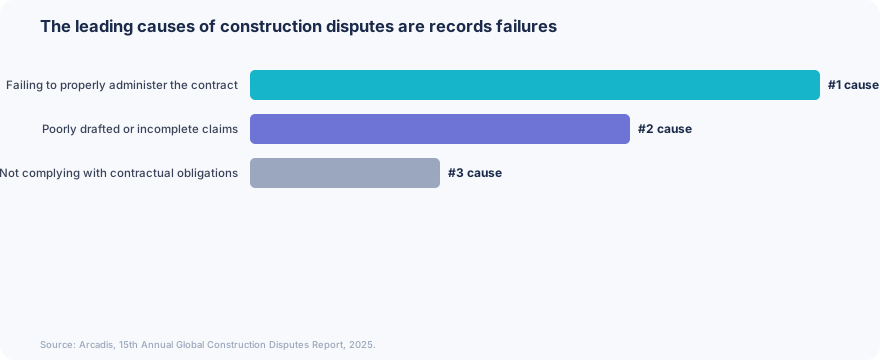
The numbers around construction disputes make the stakes concrete. Arcadis's 15th Annual Global Construction Disputes Report, published in 2025, put the average value of a construction dispute in the United States at roughly US$60 million, with North American disputes taking about 12.5 months to resolve - the fastest in a decade, but still more than a year of cost and distraction. Its leading causes are telling: year after year, the top drivers are failing to properly administer the contract, poorly drafted or incomplete claims, and parties failing to understand or comply with their contractual obligations. None of those is a problem of engineering skill. Every one is a problem of records and administration.
The file is the evidence
That is the uncomfortable insight for design and consulting firms: most disputes are won or lost not on the quality of the underlying work, but on the quality of the record of it. A 2026 forensic analysis of construction claims by Rimkus makes the same point from the evidence side - courts and tribunals prefer damages and defences grounded in contemporaneous documentation, real-time records of change-order justification beat retrospective reconstruction, and time-stamped digital records, BIM models, and laser-scanned as-builts increasingly set the evidentiary bar. The firm that can produce a clean, dated trail of who decided what, on what information, and when, is in a fundamentally different position from the one assembling its defence after a demand letter arrives.
How XNM helps
XNM helps engineering, architecture and consulting firms make the record a by-product of the work rather than a scramble after it. Where it helps, the XNM-Vision platform gives a firm one project-based command centre where drawings, revisions, calculations, correspondence, change authorizations, and the as-built record live together, dated and access-controlled - so the contemporaneous file builds itself as the project runs. When a claim surfaces years later, the firm reconstructs nothing: it opens the file. When a client, an insurer, or a regulator asks what the firm knew and when, the answer is already there. And because it deploys in days rather than the months a records overhaul usually takes, the discipline is in place before the next project - not after the next claim.
Practical takeaways
Treat the file as the deliverable. The drawing is what you hand over; the record of how you got there is what protects you. Build both.
Document decisions when you make them. A dated, contemporaneous note carries weight a reconstruction never will - in every forum that matters, it beats a confident memory.
Keep the as-built record current. What was actually built, not just what was drawn, is the version a dispute turns on; capture changes as they happen.
Make retention automatic. Claims can arrive a decade later; retention should run by system, not depend on who still works there.
Tie correspondence to the project, not the inbox. Advice and approvals buried in personal email are invisible when you need them; they belong in the project record.
FAQ
We carry professional liability insurance. Isn't that the protection?
Insurance pays a claim; it does not win one. The standard of care is assessed on the record - whether a reasonable, prudent practitioner would have done the same, judged from the file - and a strong contemporaneous record is what keeps a defensible decision from becoming an indefensible one. That protects your premiums and your reputation, not just your balance sheet.
Our work is good. Why should documentation be the priority?
Because good work and a provable record are different assets, and disputes test the second one. As the dispute data shows, most claims turn on contract administration and documentation, not on the soundness of the design itself. The firms that lose are rarely the worst engineers - they are the ones who could not show their work.
The bottom line
For a professional firm, the standard of care is not an abstraction argued in a courtroom; it is a discipline practised on every project, one dated record at a time. The deliverable proves the work was done. The record proves it was done well - and that is the asset a claim, an audit, or a regulator will test. Build the record while the work is fresh, and the firm defends from strength years later instead of reconstructing from memory.