Two of Three Districts Fell Short: Procurement Is a Records Test

When B.C.'s Auditor General looked at how three school districts buy goods and services, the headline was not fraud or waste. It was something quieter and far more common: two of the three could not consistently show that their purchasing met the province's own principles for fair and open procurement. The buying may well have been sound. The problem was the framework and the record behind it - and in public-sector procurement, an outcome you cannot evidence is, for all practical purposes, an outcome you cannot defend.
Public bodies - school districts, municipalities, health authorities, provincial agencies - spend enormous sums through procurement, and every dollar carries an obligation a private buyer does not: to be fair, to be competitive, and to be able to prove both on demand. That proof is not the contract alone. It is the whole chain: the plan, the solicitation, the evaluation criteria and how they were scored, the award rationale, and the contract management that followed. When that chain is scattered across inboxes, shared drives, and individual memory, the organization loses the one thing an auditor, a losing bidder, or a board most wants - a clean, traceable record that the right process was followed.
Recent context
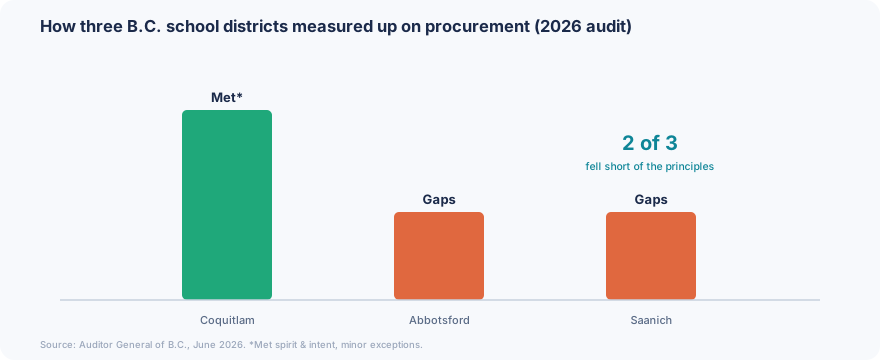
The findings are recent and specific. In June 2026 the Auditor General of British Columbia audited procurement in the Abbotsford, Coquitlam and Saanich school districts, measuring each against the province's Core Policy and Procedures Manual. Coquitlam broadly met the spirit and intent of the principles, with minor exceptions; Abbotsford and Saanich had gaps and inconsistencies that meant they fell short. The context makes the stakes plain: B.C.'s 60 school districts move roughly $800 million in procurement every year, and as Auditor General Bridget Parrish put it, an effective framework helps ensure contracts are awarded fairly, mitigates the risk of fraud, and helps government get the best value for its money.
A gap in the record is a gap in the defence
What an audit like this exposes is rarely deliberate wrongdoing; it is the slow drift that happens when procurement lives as a habit rather than a system. A district has policies, but they are not applied consistently. Evaluations happen, but the scoring rationale is not always written down. Contracts are managed, but the trail of approvals and changes is thin. None of that means a bad deal was struck - but it means the organization cannot prove a good one was, and in the public sector the burden of proof runs that way. A losing bidder's challenge, a freedom-of-information request, or the next audit all ask the same question: show me the record. When the answer is a search across drives and a reconstruction from memory, the gap in the file becomes the finding.
How XNM helps
XNM helps public bodies turn procurement from a habit into an evidenced system - without adding friction for the people doing the buying. Where it helps, the XNM-Vision platform gives an organization one command centre where each procurement's plan, solicitation, evaluation, award rationale, and contract management live together as a single dated, access-controlled record. The framework is not a binder on a shelf; it is the way the work runs, so compliance is the default and the evidence builds itself. When the Auditor General, a board, or an unsuccessful bidder asks whether the process was fair, the answer is one file away. And because it deploys in days rather than the months a procurement-records overhaul usually takes, the control is in place before the next audit, not after it.
Practical takeaways
Make the framework the workflow. A procurement policy no one can see in the system is a policy that drifts; build the principles into how purchases actually move.
Write down the evaluation rationale. Fair scoring you cannot evidence is, to an auditor, scoring that did not happen; capture the why, not just the result.
Keep the whole chain in one place. Plan, solicitation, award, and contract management belong together; a fair process scattered across drives is hard to prove.
Assume you'll be asked to show the record. Between FOI requests, bid challenges, and audits, someone will; keep the file audit-ready by default, not by year-end scramble.
Don't let memory be the system. When the person who ran a procurement leaves, the record should stay; institutional knowledge belongs in the file, not the staff.
FAQ
The audit didn't find fraud. Why is this a problem?
Because the public-sector test is not only "was this honest?" but "can you prove it was fair?" An undocumented process invites the very suspicion good records would dispel - and it is exactly the gap where waste or impropriety can hide unnoticed. The absence of evidence is itself the finding.
We're not a school district. Does this apply to us?
It applies to any body that procures with public money - municipalities, health authorities, provincial agencies, non-profits spending grant funds. The sector changes; the obligation does not. Fair, competitive, and provable is the standard everywhere public dollars are spent, and the record is how you meet it.
The bottom line
The B.C. audit is a reminder that in public procurement, doing the right thing and being able to prove it are not separate tasks - they are the same task, and the record is where they meet. Two districts did not fall short on integrity; they fell short on evidence. For any public body the fix is the same: make the framework the way the work runs, keep the whole chain in one auditable place, and the next audit becomes a file you open rather than a story you scramble to reconstruct.