Records Retention Without the Headache: A Starter Schedule

Most retention policies fail for the same reason most diets fail: they're too ambitious to actually follow. A forty-category, legally flawless schedule that nobody uses protects you exactly as much as no schedule at all — which is to say, not at all. So let's build the one you'll actually use instead.
The point of a retention schedule isn't bureaucratic tidiness. It does two jobs at once: it keeps what you're legally and operationally required to keep, and it lets you defensibly destroy the rest so it can't be held against you later. Most teams stall because they try to boil the ocean — every document type, every edge case, every statute — before they decide anything. So they keep everything forever, which feels safe and is actually a liability. By the end of this you'll have a starter schedule that's roughly 80% as protective as the perfect one, and infinitely better than the one you never finish.
Start with categories, not documents
You don't retain individual files. You retain categories. The first move is to sort everything you hold into a small number of buckets — somewhere between six and twelve for most teams. Governance records. Financial records. Contracts and agreements. Project and capital records. Personnel records. Routine correspondence. Each bucket gets one retention rule, not each document. The instinct to be precise — to give every form its own line — is exactly what kills the project before it ships. Be roughly right across all of your records rather than perfectly right across the three you reached before you gave up.
Give each bucket a trigger and a clock
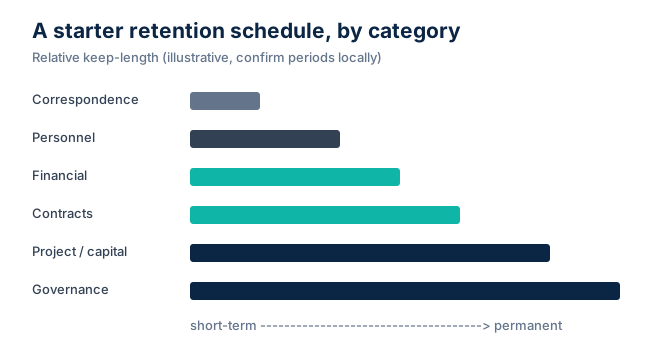
This is what turns a wish into a schedule. Each category needs two things: a trigger (the event that starts the clock) and a period (how long after the trigger you keep it). Here's a plain-English starting point — treat the periods as placeholders your jurisdiction's statutes and your own counsel will confirm, not as legal advice:
Governance records (bylaws, minutes, policies). Trigger: superseded or dissolved. Period: permanent. This is your institutional memory; it doesn't expire.
Financial records (ledgers, invoices, statements). Trigger: fiscal year-end. Period: your jurisdiction's tax and audit rule — commonly several years. Confirm the exact number locally.
Contracts and agreements Trigger: contract expiry or final completion. Period: the limitation period for disputes, plus a margin.
Project and capital records (drawings, approvals, change orders). Trigger: project closeout. Period: the life of the asset — often decades.
Personnel records Trigger: end of employment. Period: per your employment-standards and privacy law.
Routine correspondence Trigger: matter closed. Period: short. This is the bucket that quietly bloats every shared drive.
The magic word isn't complete — it's defensible
A defensible schedule is one that's written down, reasonable, and applied consistently. That last word does the heavy lifting. If you keep something one time and destroy the same kind of thing another time, that looks like selective destruction, and selective destruction is what gets organizations in trouble. If you apply one written rule to everyone, every time, that's routine records management — boring, legitimate, and protective. Consistency, not perfection, is what holds up. Which is the whole argument for starting simple: a simple rule you actually follow every time beats a perfect rule you apply unevenly.
What to do this week
Block ninety minutes. Write your six-to-twelve categories on one page. Beside each, write a trigger and a period — your best defensible guess, flagged for legal to confirm later. Then pick the single most overgrown category (it's almost always correspondence or duplicate files) and actually apply the rule to it once. That's it. You now have a retention schedule. It isn't finished — it never will be — but it exists, it's written, and you can apply it the same way every time. That single page puts you ahead of most organizations many times your size, and it turns destroying old records from a nervous judgment call into a routine you can defend.
If you want the audit side of this same coin, we put together a plain-English starter on getting ready before the auditor arrives in our Field Guide series.