One Chart: The Document-Drift Curve

On the day you create a document, you can find it in seconds. You know what it is, where it lives, which version is real, and why it exists. That is the best that document will ever be. From that moment on, findability only decays.
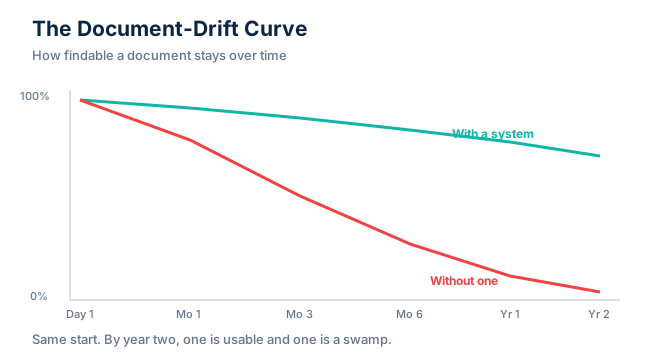
We treat lost documents as accidents — a one-off, a bad day, someone's mistake. They aren't accidents. They're the predictable output of a curve, and the curve is steeper than anyone wants to admit. Below is the Document-Drift Curve: how findable a document stays over time, with a system and without one. The shape is the entire argument, and once you've seen it, you can't unsee it in your own drives.
Why the curve bends down: three quiet forces
Three forces pull every document toward unfindable, and none of them is dramatic. The first is version multiplication: the file gets copied, edited, renamed, and emailed, and now five near-identical versions exist while only one is real. The second is context evaporation: the reason the document exists — the decision it supported, the conversation around it — lives in memory, and memory fades fast. The third is turnover: the person who knew where it was and why it mattered walks out the door and takes the map with them. None of these is a crisis on any given day. All of them are constant. Together, they bend the curve down a little every single week.
A system doesn't stop time — it flattens the curve
Look again at where the two lines start. On day one, they're identical. Everything is findable; you don't need a system to find a document you made this morning. The system earns its keep at month six and year two, where the unmanaged curve has fallen off a cliff and the managed one is still up where you can actually use it. That's the counterintuitive part — and the reason this work is chronically deprioritized. The value of good records is nearly invisible at setup, when finding things is easy anyway, and enormous later, when you need them and they're gone. You're not filing for today. You're filing for the version of you who gets the records request, the audit, or the lawsuit eighteen months from now.
Find your own curve this week
Here's a test you can run before Friday. Pick three documents: one from this month, one from a year ago, and one from a project that has since closed. Time how long it takes to find the current, authoritative version of each — not a copy, the real one. Those three numbers are your Document-Drift Curve. If the year-old one takes ten times longer than this month's, you've just measured the cost of having no system — and you've found the strongest possible argument for building one before your next document starts its slide. The curve is always running. The only question is how steep you let it get.
We measured this same decay from the other direction — how fast a tidy drive becomes a swamp — in another One Chart piece.