The $126-Billion Question: Why Aging Municipal Assets Are a Records Problem First
Canada's first National Infrastructure Assessment put a number on a problem every council already feels in its bones: roughly $126 billion of the country's public infrastructure is in poor or very poor condition. Released in late 2025, the assessment landed in a year when the housing the country is counting on depends on the water mains, roads, and treatment plants that municipalities own and operate. The headline is the dollar figure. The harder story underneath it is that a municipality cannot renew - or even defensibly prioritize - what it cannot see in its own records.
Municipalities maintain the bulk of Canada's core public infrastructure - roads, bridges, water and wastewater systems, transit, recreation and cultural facilities - on roughly eight cents of every tax dollar collected in the country. The records that describe those assets are the operating manual for the whole portfolio: as-built drawings, condition assessments, maintenance histories, capital plans, warranty and contract files, and the council decisions that authorized each project. When those records are scattered across departments, consultants' servers, aging spreadsheets, and the memories of staff approaching retirement, asset management stops being a discipline and becomes an act of faith.
Recent context
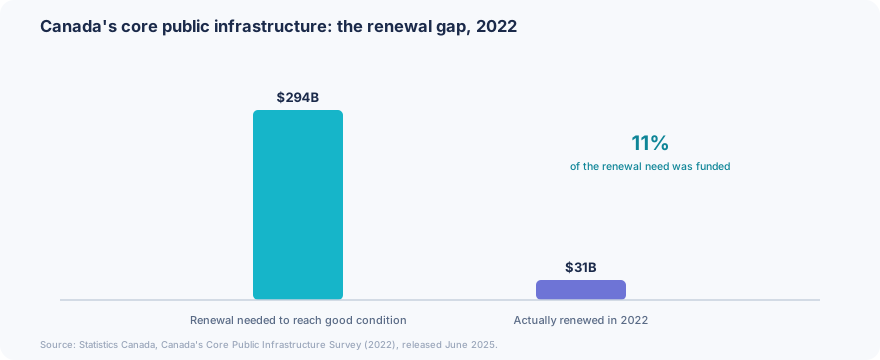
The renewal gap is now measured. Statistics Canada reported in June 2025 that at the end of 2022, infrastructure owners estimated $294.4 billion was needed to rehabilitate or replace core public assets to good condition - yet only $31.3 billion, about 11% of the required renewal, was actually invested that year. Over the same period, the share of assets in good or very good condition slipped from 59% in 2020 to 55% in 2022. The backlog is not just large; it is widening.
Renewal is a data problem before it is a money problem
It is tempting to read these numbers as a funding story, and funding is real. But no order of new money gets spent well if the underlying record is thin. Prioritizing $294 billion of need across hundreds of thousands of individual assets - which culvert fails first, which bridge moves up the list, which water main is one winter from a break - is impossible without a current, trustworthy inventory of what exists and what condition it is in. That is why the national assessment's own recommendations lead with standardized data, asset management, and transparent risk assessment, not just more capital. The gap compounds too: rural municipalities, with less staff capacity, carry an outsized share of the renewal burden, and the smaller the team, the more the institutional record lives in one or two people's heads.
How XNM helps
XNM helps municipalities pull the asset and capital-project record into one auditable command centre - as-builts, condition data, maintenance and warranty files, contracts, change orders, and the council decisions behind them, tied together and kept current. Where it helps, the XNM-Vision platform gives a city manager or asset-management director a single line of sight across the whole portfolio, so the renewal list is built on evidence rather than the loudest complaint. When a funding application, an auditor, or a council committee asks why this project and why now, the answer already exists in a defensible form. And because it stands up in days rather than the many months a records overhaul usually takes, the visibility arrives in time to shape the next capital budget, not the one after it.
Practical takeaways
Treat the asset inventory as core infrastructure. A renewal plan is only as good as the record of what you own; an out-of-date inventory quietly mis-prioritizes every dollar.
Tie condition data to capital decisions. The point of condition assessments is to drive the renewal list - keep them in the same place the budget is built, not in a consultant's PDF.
Make the capital file audit-ready by default. Grant funders and auditors will ask what was approved and why; keep the record in a state where the answer is already there.
Give leadership one portfolio view. A council overseeing thousands of assets needs a single, current picture - not a binder per department refreshed once a year.
Capture institutional memory before it walks out the door. When a long-serving engineer retires, the project history should stay with the municipality, not leave with them.
FAQ
We already have an asset management plan. Isn't that enough?
A plan is the intent; the record is what keeps it true. Plans built on a one-time inventory drift out of date as assets age and projects close. The value is in a living record where condition, work history, and capital decisions update together - so the plan reflects the network as it is now, not as it was at the last assessment.
Isn't this really just a funding shortfall?
Funding is part of it, but visibility is the part a municipality controls. New money spent against a thin record buys less renewal than the same money spent against a clear one. Getting the record right is how you make every dollar - existing or new - reach the asset that needs it most.
The bottom line
A $126-billion condition gap is a governance story before it is a construction story. The municipalities that will close it are the ones that can see their own networks - every asset, its condition, and the decisions shaping its future in one current, defensible record. You cannot renew what you cannot see, and the record is how a council learns to see.