The Email That Sank a Bid

The clarification took thirty seconds to type. A project engineer, fielding a bidder's question two days before tender close, wrote back: yes, that scope is included, don't price it separately. He hit send, closed his laptop, and moved on. Fourteen months later, that one email was the whole argument.
The bid came in. The contract was signed. The work started. Then came the moment every engineering firm dreads: a six-figure disagreement over what the price was supposed to cover. The contractor pointed to the email. The owner had never seen it. The official addenda — the issued-to-all-bidders clarifications that become part of the contract — said nothing about it. So now there were two versions of the truth: one in a signed contract, one in a sent-items folder. And the thing about two versions of the truth is that people get paid to argue which one counts. By the end of this you'll see why the email itself wasn't the problem — and what a single discipline would have prevented.
A clarification that lives in one inbox isn't a clarification
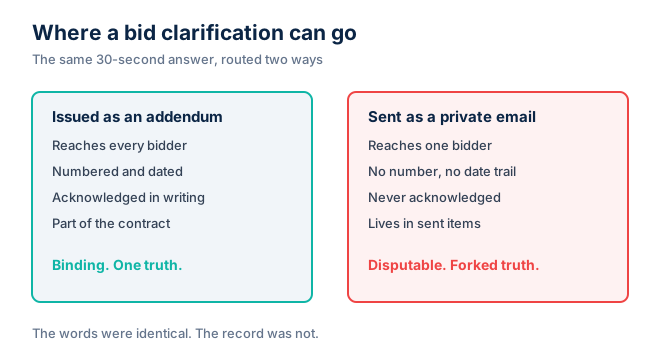
The engineer wasn't careless. He answered a fair question quickly and helpfully, which is exactly how good engineers work. The failure was structural, not personal. On a competitive tender, every bidder is supposed to price the same scope, and the only way that holds is if every clarification reaches every bidder through one controlled channel: the addendum. An addendum is issued, numbered, dated, and acknowledged. It becomes part of the contract documents. An email to one bidder does none of that. It changes the scope for one party, in private, with no number, no acknowledgment, and no place in the record everyone else can see.
So picture what actually happened. The other bidders priced the published scope. This one priced a slightly different scope, based on a private answer nobody else received. The tender was no longer apples to apples — and nobody noticed, because the difference was invisible until real money depended on it. The helpfulness was real. The routing was the flaw.
Why the dispute was really a documentation dispute
Strip away the legal posturing and the fight came down to one question: what did the parties actually agree to? In a well-run project, that question has a boring answer. You open the contract documents, you read the addenda in order, and the scope is whatever they say it is. There is one trail, and it is complete. Here there were two trails, and they forked. The contractor's trail ran through a sent email. The owner's trail ran through the signed documents. Neither side was lying. They were each reading a different record.
That is what an undocumented — or wrongly documented — clarification does. It doesn't just create a gap; it creates a contradiction. And a contradiction is far more expensive than a gap. A gap you can fill in an afternoon. A contradiction you have to argue, sometimes for fourteen months, because two people are each holding a piece of paper that says they're right.
Make the formal record the only record that counts
The rule that would have saved fourteen months fits on a sticky note: if an answer changes scope, price, or schedule, it is not given until it is in the formal record. Not the moment you type it — the moment you issue it where every party can see it and acknowledge it. A verbal answer at a site walk, a quick email to a keen bidder, a hallway yes-that's-fine: all of it is fine to say, and none of it is binding until it lands in the addendum, the RFI log, or the change record. The discipline isn't about being less helpful. It's about routing every helpful answer into the one place the contract actually reads from.
Keeping every clarification, RFI, and change in one auditable trail is exactly the kind of problem we built XNM-VISION to take off people's plates. But the principle holds with nothing fancier than a numbered addenda log: if it changes the deal, it goes in the record everyone can see, or it didn't happen.
So look at how clarifications flow out of your office this week. When a bidder or a contractor asks a question that moves the scope, where does the answer go? If it can leave in a private inbox without ever touching the formal record, you don't have a clarification process. You have fourteen-month disputes waiting for a trigger. The fix is not to answer fewer questions. It's to make sure every answer that matters can only live in one place.
We trace a different one of these failures back to its root every week in our Anatomy of an Overrun series.