When the Auditor Comes for the Assets: Why a Crown Corporation Runs on Its Record
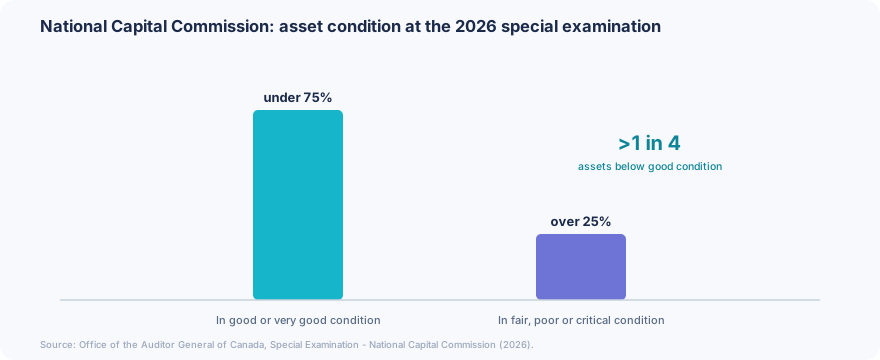
A Crown corporation exists to hold something in trust for the public - land, buildings, infrastructure, a mandate - and to steward it across decades and changes of government. That trust is measured, eventually, by an auditor. When the Auditor General of Canada completed its special examination of the National Capital Commission in 2026, it found a significant deficiency in the corporation's asset maintenance, and the number behind it was stark: more than a quarter of its assets were in fair, poor, or critical condition, against an estimated shortfall in the resources needed to restore them. The finding is specific to one corporation, but the lesson is general. Stewardship is not what an agency intends; it is what the agency can show.
Public agencies and Crown corporations run on a record the way a bank runs on its ledger. The asset register, the condition assessments, the capital and maintenance plans, the board decisions that set priorities, and the risk information that flows to directors are not administrative overhead - they are the evidence that the public's assets are being cared for. When those records are fragmented, out of date, or trapped in the knowledge of a few long-serving staff, two failures follow at once. The agency cannot prioritize its limited restoration dollars against a clear picture of condition, and it cannot demonstrate to its board, its minister, or the auditor that it is managing the risk it was entrusted to manage. The condition of the assets and the condition of the record decline together.
Recent context
The finding is on the public record. The Auditor General of Canada's 2026 special examination of the National Capital Commission identified a significant deficiency in asset maintenance - more than a quarter of assets in fair, poor, or critical condition - and noted that the board did not always receive comprehensive risk information for its decisions, including a clear description of the risk that the corporation might lack the resources to restore and preserve its assets. The auditor's recommendation was not simply to spend more, but to build a complete analysis of what restoration actually requires and to surface that risk properly through the corporate planning process.
Stewardship you cannot document is stewardship you cannot defend
It is tempting to read an asset-maintenance finding as a funding problem, and funding pressure is real for almost every public agency. But the auditor's own emphasis points elsewhere first: to the completeness of the analysis and the quality of the information reaching the board. You cannot credibly ask government for the resources to restore a portfolio until you can show, asset by asset, what condition it is in and what restoration costs. And a board cannot govern a risk it is not clearly shown. Both of those are records problems before they are money problems. A current, trustworthy record of every asset, its condition, its maintenance history, and the decisions taken about it is what converts a vague sense that things are aging into a defensible plan - and what lets a board say, on the record, that it saw the risk and acted. When the auditor arrives, that same record is the difference between demonstrating stewardship and promising it.
How XNM helps
XNM helps Crown corporations and public agencies pull the asset and capital record into one auditable command centre - the asset register, condition assessments, maintenance and capital-project histories, contracts and change orders, and the board and committee decisions that authorized them, tied together and kept current. Where it helps, the XNM-Vision platform gives directors and management a single, current view of the portfolio and the risks attached to it, so restoration dollars are prioritized on evidence and the board receives the comprehensive picture the auditor expects it to have. When a special examination or a public accounts committee asks what condition the assets are in and how the agency knows, the answer already exists in a defensible form. And because it stands up in days rather than the many months a records overhaul usually takes, the visibility arrives before the next audit cycle, not after it.
Practical takeaways
Make the asset register the single source of truth. Stewardship starts with knowing what you hold and its condition; a fragmented or stale register mis-prioritizes every restoration dollar.
Give the board comprehensive risk information. Directors can only govern a risk they are clearly shown; put asset-condition and resource risk in front of them in a form they can act on.
Base restoration asks on a complete analysis. Government funds a costed plan, not a worry; show asset by asset what restoration requires before asking for the resources to do it.
Keep the record audit-ready by default. A special examination can come at any point in the cycle; keep condition, decisions, and histories in a state where the answer is already there.
Hold institutional memory in the system, not in people. When long-serving staff retire, the knowledge of what was maintained, when, and why should stay with the agency, not leave with them.
FAQ
We have an asset management plan and annual reports. Isn't that enough for the auditor?
A plan and a report state intent and outcome; an auditor tests the evidence beneath them. The findings that become significant deficiencies live in the gap between 'we have a plan' and 'we can show, asset by asset, its current condition, the analysis behind our priorities, and what the board was told.' A living record closes that gap - it is what turns a plan into something an examination can verify.
Isn't a maintenance backlog fundamentally about not having enough money?
Resources are part of it, but the part an agency controls is visibility. You strengthen a funding case by proving, with a complete costed analysis, exactly what restoration needs - and you protect the board by showing the risk clearly. A thin record weakens both the ask for money and the governance around it; getting the record right is how a limited budget reaches the assets that need it most.
The bottom line
A significant deficiency in asset maintenance is, at its root, a governance and records story - a portfolio the agency could not fully see, and a risk the board was not fully shown. The Crown corporations and public agencies that pass their next examination will be the ones that can produce a current, defensible record of every asset, its condition, and the decisions behind it. Public trust is proven, not asserted, and the record is how an agency proves it.