Field Notes: Housing Non-Profits and the Capacity Test
Tell a community housing non-profit to double the number of homes it delivers and the room pictures cranes, framing crews, and ribbon-cuttings. Then, a year in, the thing that actually slows them down is none of those. It's a request from a funder for the unit-by-unit cost breakdown on last quarter's build - and the realization that the answer lives in three inboxes, a site manager's memory, and a spreadsheet last touched by someone who left in March.
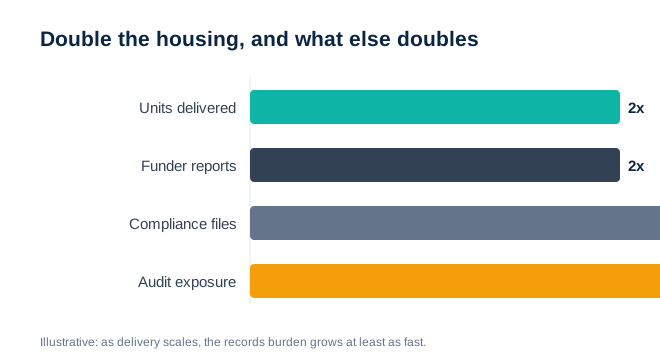
Here's the pattern we keep seeing in the field: scaling housing delivery is only half a construction problem. The other half - the half that stalls good organizations - is a records-and-capacity problem. Every home you build comes attached to reporting obligations, and those obligations don't grow gently. Double the units and you don't double the paperwork; you more than double it, because more funders, more conditions, and more audits pile on top of more builds.
Why doubling delivery more than doubles the record
A single project has one funding agreement, one reporting rhythm, one set of conditions. Grow, and you don't just repeat that - you layer it. A second funder wants different milestones. A capital grant demands photos and invoices per unit. A subsidy program requires tenant eligibility files. Each new source of money arrives with its own definition of "proof," and the intersections multiply faster than the buildings do. The construction scales linearly. The compliance scales worse.
This is the capacity test, and it is rarely about staff count. It's about whether the organization has a spine for its records - a consistent place where every unit's costs, approvals, permits, and reports live, so that answering a funder is a lookup, not an excavation. Organizations that built that spine early scale almost boringly. Organizations that didn't hit a wall the moment their second or third funder asks a question the first one never did.
What the organizations that scale do differently
The ones that make the leap tend to share a few habits, none of them glamorous:
They keep one file per unit, from land to lease-up, so any funder's question maps to a single place instead of a scavenger hunt across departments.
They record the decision, not just the outcome - who approved the change order, on what date, against which budget line - because next year's audit will ask.
They treat the funding agreement's reporting schedule as a live calendar with owners, not a PDF read once at signing.
They standardize before they grow, so the second project inherits the first project's structure instead of inventing a new one.
None of that requires a bigger budget. It requires deciding, before the growth arrives, that the record is part of the deliverable - not an afterthought bolted on when a report comes due. The mission is housing; the constraint is provability. An organization that can't show a funder where every dollar went will spend its scarce capacity defending the past instead of building the future.
The test you can run this week
Pick one completed unit and ask a simple question: could a new staff member, with no institutional memory, assemble the full cost, approval, and compliance record for it in an afternoon? If yes, you can probably double. If it takes a week of asking around, that week is your real ceiling - and it will get taller with every home you add. Fix the record before you scale the build, and the growth stops being a test you might fail.
Capacity isn't only people - it's provability. more field notes on the records behind the mission are here.