One Chart: The Rework Caused by Bad Documents
A crew poured a wall to the wrong dimension. Not because they were careless - because they built from Revision C while the architect had already issued Revision D, and Revision D moved the opening eight inches. The wall was perfect. It was also wrong, and it came out with a jackhammer. Nobody made a mistake at the trowel. The mistake was upstream, on paper, days earlier, and it cost real money to undo.
That's the quiet story behind a surprising amount of construction rework. Some rework is genuinely unavoidable: ground conditions surprise you, an owner changes their mind, a design evolves. But a stubborn share of it isn't about the build at all - it's about the document the build was based on. Wrong revision, missing dimension, a spec that contradicts the drawing, an RFI answered verbally and never written down. Preventable, every one.
Why the document error is the expensive one
A document error is uniquely costly because it hides until it's built. A field mistake gets caught by the next inspection; a material defect shows up on delivery. But a wrong-revision error passes every check - the crew executes it perfectly, the foreman signs off, the work looks right - because everyone downstream trusted a drawing that was already stale. You don't discover it until the correct information finally surfaces, and by then the concrete has cured.
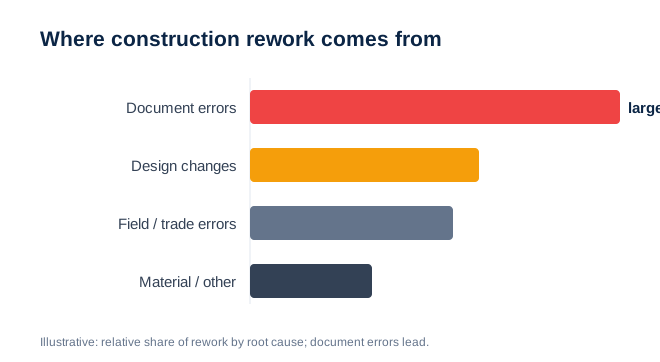
That's what makes document control feel invisible until it fails. When it works, nothing happens - which is exactly why it's underfunded. The chart below shows the pattern we see when teams actually trace their rework back to root cause: the single largest slice usually isn't bad workmanship or surprise conditions. It's the paper.
The fix is upstream, and it's cheap
You cannot inspect your way out of a document problem, because the work will pass inspection. You have to fix it before the crew ever picks up a tool. Three habits do most of the work:
One controlled source of the current set. A single place where the latest revision lives, so "which drawing?" has one answer and superseded sheets are visibly retired.
Revisions that are impossible to miss. Clear version stamps and a change log, so a field crew can tell in seconds whether the sheet in their hand is current.
RFIs and answers in the record, not the air. Every clarification written down and attached to the affected drawing, so a verbal "yeah, move it" can't become tomorrow's demolition.
This is precisely the failure a single source of truth is built to prevent - and it's a core reason platforms like XNM-VISION keep the drawing, the revision history, and the RFI trail in one auditable place. But the principle matters more than any tool: if the crew can build from a stale sheet, eventually they will, and you'll pay for it in concrete.
Tomorrow, ask your last rework event one question: was the information wrong, or was the work wrong? If it was the information, no amount of better craftsmanship would have saved you - and the cheapest place to catch the next one is on the screen, before anyone lifts a tool.
Rework from a stale drawing is an overrun that started at a desk, not on the deck - see how a document error becomes a budget line.