The Sole-Source Justification No One Kept
The contract was awarded in four days. Nobody had time to run a competition - the water plant needed a proprietary control part, one manufacturer made it, and the plant could not wait for a thirty-day tender. So the manager signed the sole-source award, the vendor delivered, and the crisis passed. Three years later an auditor asked one simple question: show me why you didn't compete this purchase. And there was nothing to show.
The buy was almost certainly fine. The part really was proprietary; the urgency was real. But "almost certainly fine" is not what an audit runs on. An audit runs on the written justification - the memo that says, at the time of the decision, here is exactly why a single source was the only reasonable option. That memo was never written, or was written in a hurry and never kept. And in public procurement, a missing justification isn't a footnote. It's the finding.
Why the justification is the whole point
In a competitive procurement, the market defends you. Several bids on the record prove you sought a fair price and ran an open process. The paper trail builds itself, almost as a by-product of following the steps. A sole-source award strips that defense away. You have told the public you spent their money without shopping it - and the only thing standing between that decision and an audit finding is your contemporaneous explanation of why it was justified.
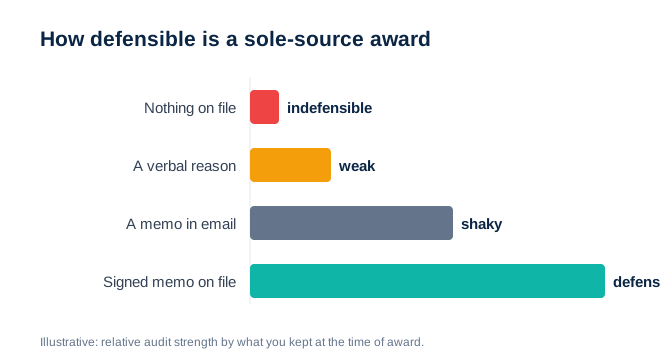
That is the trap. Skip the memo and you have not merely misplaced a document. You have removed the single piece of evidence that makes the entire award defensible. The purchase can be completely legitimate and still fail an audit, because the audit does not test whether you were right. It tests whether you can prove you were reasonable at the moment you decided. No memo, no proof.
What a defensible justification actually contains
It is far shorter than people fear - usually under a page. A justification that survives scrutiny answers four questions in plain language:
The need and the urgency. What was required, by when, and what happened if it wasn't met - the operational reason a normal competition wasn't workable.
Why only this source. The specific reason no other vendor could satisfy the need: sole manufacturer, proprietary interface, patent, or an incumbent whose replacement would cost more than the award.
How you know the price is reasonable. A comparison to a prior contract, a catalogue rate, or an independent estimate - anything showing you didn't simply pay what you were asked.
Who approved it. The name, title, and date of the person with authority to waive competition, signed at the time, not reconstructed later.
None of that takes long to write. The failure is almost never the writing - it's that nobody owned the record. The manager assumed procurement kept it; procurement assumed the manager filed it; the vendor was paid and everyone moved on. The justification existed in four people's memories and zero drawers.
The fix is a habit, not a system
You don't need new software to close this gap - you need a rule with teeth: no signed justification on file, no award released. Make the memo a required field in the approval, attach it to the same record as the contract, and give one named person the job of confirming it exists before the purchase order goes out. A sole-source award without its justification should be as unthinkable as a cheque without a signature.
Tomorrow morning, do one thing: pull your last twelve months of sole-source and emergency awards and check each one has a signed justification attached. The ones that don't are your exposure - and they are far cheaper to fix today, quietly, than to explain to an auditor eighteen months from now. The decision was defensible when you made it. Make sure it still is when someone asks.
A justification no one kept is the same failure as an approval no one could find - just wearing a different hat. more field notes on the records that decide audits are here.