When Owners Share the Project, They Share the Record: Indigenous Equity in Major Energy Builds

Something fundamental has shifted in how major energy projects get built in Canada. For a generation, the relationship between a proponent and the Indigenous nation whose territory it crossed was framed as consultation - a duty to inform and accommodate. Increasingly, it is framed as ownership. Nations are not just at the table; they hold equity, share in the upside, and carry the responsibilities that come with being an owner. And one of those responsibilities is rarely discussed but always present: an owner is entitled to see, and account for, exactly how the project is run.
That changes the records relationship at the heart of a project. A consulted party receives updates; an owner audits the books. When an Indigenous nation holds a real equity stake, it needs - and is entitled to - a clear, current, trustworthy line of sight into budgets, contracts, change orders, and the decisions moving the project. A shared project cannot run on two versions of the truth: the operator's records and the partner's separate, partial picture pieced together from meetings. Shared ownership demands a shared record - one set of books both sides can trust, where every dollar and decision traces back to the document behind it.
Recent context
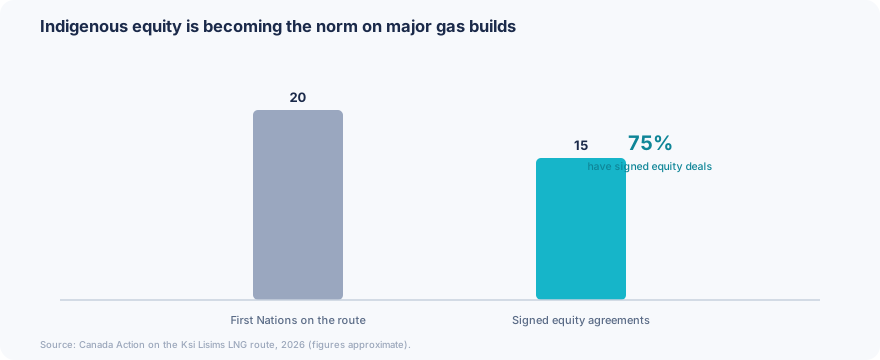
The equity model is now the leading edge of Canadian energy. In May 2026 Canada and BC reached an enhanced investment-cooperation agreement to advance LNG Canada's Phase 2, with collaboration with First Nations named as a core objective and a final investment decision targeted by year-end. It builds on a template the Haisla Nation set with Cedar LNG - the largest Indigenous-owned infrastructure project in the country - and a broader trend the Canada Energy Regulator has documented: growing Indigenous ownership across Canadian pipelines and LNG facilities. Equity, not just consultation, is becoming the norm.
Shared ownership is a governance test
Equity is a powerful form of reconciliation precisely because it is real: real money, real risk, real say. But it raises the bar on governance for everyone involved. An Indigenous development corporation taking an ownership stake takes on a fiduciary duty to its members to oversee that investment - which it can only do with access to a record it can actually rely on. And the operator now answers to a partner with the standing to ask hard questions and the right to real answers. A project where the partners cannot see the same trustworthy record is a dispute waiting to happen. A project where they can is a partnership that holds under pressure.
How XNM helps
XNM helps joint-venture partners and Indigenous development corporations work from one shared, auditable project record - budgets, contracts, change orders, approvals and the decisions behind them, tied together and visible to the partners who are entitled to see them. Where it helps, the XNM-Vision platform gives an Indigenous owner a real, current line of sight into the investment rather than a periodic summary, and gives the operator a single source of truth instead of reconciling parallel files. Access can be governed so each partner sees what their stake entitles them to. And because it stands up in days rather than the months a records overhaul usually takes, the shared record can be in place as the partnership forms - not retrofitted after a disagreement.
Practical takeaways
Build the shared record into the deal. If a partner holds equity, their line of sight into the books is part of the agreement, not an afterthought.
Run one source of truth, not two. An operator's record and a partner's reconstructed picture will diverge; a shared record keeps both sides on the same facts.
Govern access by stake. Each partner should see what their ownership entitles them to - provable, not informal.
Give the Indigenous owner real oversight. A development corporation's fiduciary duty to its members needs current evidence, not a quarterly slide.
Set the record up front. A shared record built as the partnership forms is far cheaper than one assembled during a dispute.
FAQ
We already share project updates with our Indigenous partner. Isn't that enough?
Updates are what you share with a stakeholder; a shared record is what you owe a co-owner. An equity partner has both the right and the duty to verify, not just be informed - and that requires access to the underlying documents, not a curated summary. The difference is the difference between consultation and ownership.
Won't a shared record expose sensitive commercial information to all partners?
A good shared record is access-governed, not all-or-nothing: each partner sees what their stake and the agreement entitle them to, provably. That is more secure than the alternative, where sensitive files circulate by email and no one can say for certain who has seen what.
The bottom line
As Indigenous nations move from consulted parties to co-owners of major energy projects, the project record stops being the operator's private file and becomes shared property. Ownership carries the right to see the books and the duty to account for them - and a partnership only holds if both sides can trust the same record. The projects that make equity work are the ones built on one set of books everyone can rely on.