The Decades-Long Liability: Why Mine Closure Lives or Dies on the Record
A mine produces ore for a couple of decades. The obligation to close it properly can run for several more. Long after the last truck leaves, someone has to prove the cover system performs, water quality holds, and the security posted years ago still matches a liability that has quietly grown. That proof is not in the rock. It is in the closure record - the only thing between a managed obligation and one that reverts to the public.
For a VP of sustainability or closure, this is the defining feature of the role. You are accountable for an event that may not happen for thirty years, governed by a plan written today and secured by an instrument a regulator will revisit again and again. Each annual reclamation report, cost estimate and monitoring result is a brick in a wall you will need standing decades from now. Lose the continuity of that record through staff turnover, an ownership change or a botched migration, and the obligation does not disappear - it just becomes harder to defend.
Recent context
The cost of getting the numbers wrong is now a headline. As The Globe and Mail reported in December 2025, Alberta's Auditor-General found the province's Mine Financial Security Program held roughly C$1.8 billion in security against an estimated C$51.9 billion oilsands reclamation liability, and warned that if the asset values behind the program are overstated, Albertans could end up paying for the cleanup. The gap is a public-policy debate, but underneath it sits a records question: every dollar of that liability rests on documented cost estimates that have to be current, traceable and defensible.
A liability that grows while you look away
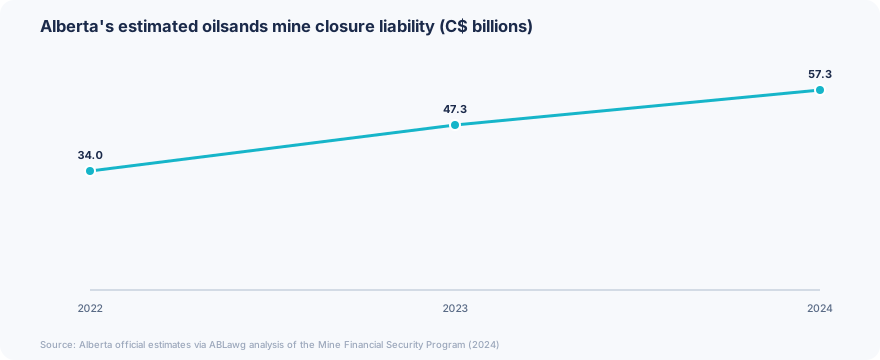
What makes closure dangerous is that the obligation moves. Alberta's official estimate of oilsands closure liability climbed from roughly C$34 billion to C$47.3 billion in 2023 and to C$57.3 billion in 2024 - a jump driven by updated cost assumptions, not new mines. A closure number set in a plan five years ago is almost certainly wrong today. If the supporting record - cost basis, disturbance footprint, monitoring history - is scattered or stale, the company cannot see the drift until a regulator points it out, and by then it is a finding, not a managed update.
British Columbia's framework makes the same point from the operator's side. Major mines must file annual reclamation reports and reclamation liability cost estimates, and posted security is only returned once a site is reclaimed to a satisfactory standard with no remaining monitoring obligations - a record-keeping promise that spans the full life of the asset. The company that can show a clean, continuous trail from disturbance to certified reclamation eventually gets its security back; the one that cannot stays on the hook.
How XNM helps
XNM is built for obligations that outlive the people who created them. The XNM-Vision platform consolidates a mine's closure record - the closure plan and its revisions, annual reclamation reports, cost estimates, financial-assurance instruments, monitoring data and the audit trail behind every change - into one auditable system organized by site and obligation, not by the consultant or year that produced each file. When the liability estimate moves, the basis is visible. When a regulator asks for the history behind a number, it is one retrieval, not a search across legacy drives and former owners' archives. Because it organizes records you are already required to produce rather than replacing your environmental systems, it stands up in days, not the months a full records overhaul usually takes.
Practical takeaways
Treat the closure estimate as a living record. Liabilities drift with cost assumptions. Keep the cost basis current and traceable so an update is routine, not a surprise finding.
Organize by site and obligation, not by author. Closure records outlive the consultants and owners who create them. A site-keyed record survives turnover and acquisitions intact.
Preserve the chain of custody on financial assurance. The instrument, its renewals and the liability it secures must trace to each other. A broken link is a regulator's first question.
Make the monitoring history one continuous thread. Reclamation is proven over years of data. Fragmented records weaken the case for security release at the end.
Plan the handover before it happens. Most closure records fail during an ownership change or migration. Build the record so it can be handed over whole.
FAQ
We posted security years ago. Isn't the obligation handled?
Security is sized to a liability estimate, and that estimate moves - Alberta's rose by more than C$20 billion in two years. If the documented cost basis is not kept current, posted security can fall out of step with the real obligation, exactly what auditors flag.
Why does record continuity matter so much for closure?
Closure obligations commonly outlast a mine's operating life and several changes of ownership, and security is often released only once reclamation is certified - decades out. Without a continuous record from disturbance to certification, the company cannot prove it met the standard and stays liable.
The bottom line
A mine's closure obligation is a multi-decade liability that grows quietly and is settled only on proof. Alberta's widening gap between posted security and estimated cost is a warning about what happens when the documented basis of that obligation drifts out of view. The companies that treat closure as a continuous, auditable record - not a plan filed once and forgotten - keep the obligation manageable and, eventually, get their security back. The record is what stands between a closed mine and a reverted liability.