Field Notes: Why Law Firms Sit on a Records Goldmine (and a Risk)

A litigator spends two hours rebuilding an argument her firm already won three years ago — in a matter she never worked on — because the brilliant brief that nailed it is buried in a closed-matter folder nobody can search. The knowledge is in the building. It just isn't findable. That's the law firm records problem in one sentence, and it cuts both ways.
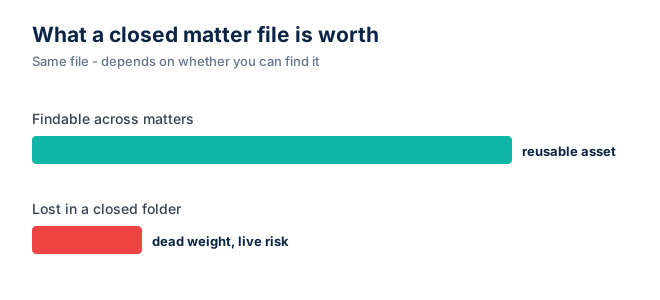
Because the same file that should be the firm's richest asset is also its sharpest liability. Most firms treat it as neither. They treat it as storage — somewhere closed matters go to sit quietly until a retention clock no one is watching runs out. Held that way, a matter file does nothing for you and quietly accumulates risk. Held deliberately, it does the opposite.
The goldmine: every matter is reusable knowledge
A firm's matter files are the most expensive knowledge it owns. Inside them sit winning briefs, negotiated clauses that survived the other side's lawyers, expert witnesses who delivered, research that took a junior fifty hours the first time. A firm that can find its own past work bills faster, pitches with proof, and trains its associates on real precedent instead of starting cold. But that value only exists if the work is findable across matters — by issue, by clause, by outcome — and not locked inside a per-client folder that only the original team remembers.
The risk: the same file can sink you
Turn the file over and the asset becomes exposure. The matter file is where privilege has to be protected, where retention obligations have to be met and then honoured by disposing of what's past its date, where conflicts get checked, where client confidentiality lives or dies. A privileged document filed in the wrong place, a record you're obligated to produce but can't locate, a file destroyed too early or kept too long — each is a professional and ethical problem hiding in what looks like a dusty archive. The matter file is also where malpractice exposure quietly waits.
Treat the matter file as a managed asset
The firms pulling ahead do a few unglamorous things. They index across matters, not just within them, so a clause or an argument can be found by anyone entitled to see it. They run a real retention schedule — keeping what they must, defensibly disposing of the rest on time. They mark privilege deliberately, at the moment of filing, not in a panic during discovery. And they make closed work searchable to exactly the people allowed to search it. The same file, governed this way, moves off the liability side of the ledger and onto the asset side.
The matter file isn't going anywhere; the only question is whether it works for the firm or against it. Left as storage, it's a slow leak of both value and safety. Treated as the managed asset it actually is, it's the closest thing a firm has to compounding institutional memory — and the cheapest insurance it will ever buy.
We look at how a different sector lives the same records reality every week in our Field Notes series.