The Permit That Expired in a Drawer

The notice came on a Tuesday. A provincial inspector stood at the gate of a mine site that had been running smoothly for four years and asked, almost as a formality, to see the current operating permit. The superintendent walked to the records cabinet, opened the right drawer, and found the permit exactly where it belonged. It had expired eleven days earlier.
Work stopped that afternoon. Not because anyone had done anything wrong on the ground — the site was safe, compliant, and producing — but because the single piece of paper that authorized all of it was no longer valid. The renewal was routine. The fee was small. The application would have taken an afternoon. And yet the cost of missing it ran into a stand-down measured in days: idle crews, a halted haul cycle, and a remobilization that nobody had budgeted for. Here is the uncomfortable part. Nobody had forgotten the permit. The renewal date was sitting right there in the file. What had been forgotten was whose job it was to act on it.
A deadline with no owner is a deadline that will pass
The permit had been secured years earlier by a consultant who had long since rolled off the project. The original project manager had moved to another site. The renewal date lived in the document itself — printed clearly on page one — but it had never been lifted out of the document and turned into a task with a name attached. So it sat. Everyone assumed someone was watching it, which is the same thing as no one watching it. The information was perfect. The ownership was missing. That gap is where the eleven days came from.
This is the quiet pattern behind a startling share of compliance failures. It is rarely that the obligation was unknown. It is that the obligation was known by the file and not by a person. A renewal date trapped inside a PDF is inert. It does not escalate, it does not nag, and it does not care that the consultant who filed it is gone. It waits, and then it lapses, and the first reminder you get is an inspector at the gate.
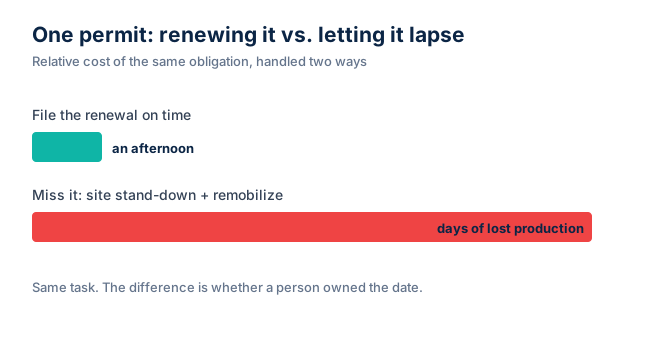
Turn every expiry into a task with a name on it
The fix is not a better filing cabinet. The fix is to treat every date that can lapse — permits, licences, insurance certificates, bonds, tenure renewals — as a living obligation that belongs to a named person and surfaces well before it bites. The date comes out of the document and into a place that watches it on your behalf, with an owner, a lead time, and an escalation if the owner goes quiet. When the consultant rolls off, the obligation does not roll off with them; it is reassigned, because it lives somewhere a person checks, not somewhere a person hopes.
This is exactly the kind of silent, ownerless deadline we built XNM-VISION to surface before it becomes an inspector at the gate. But the principle stands whatever you use to do it: a renewal date is not handled until it has a name and a reminder, not just a place in a drawer.
So ask one question about your own operation tomorrow morning: of every permit, licence, and certificate that keeps you legally running, which ones have a person — a specific, reachable, currently-employed person — who would lose sleep if it lapsed? If you cannot name them for each one, you do not have a tracking system. You have a drawer, and a drawer never sends a reminder.
We take apart a different one of these every week in our Anatomy of an Overrun series.