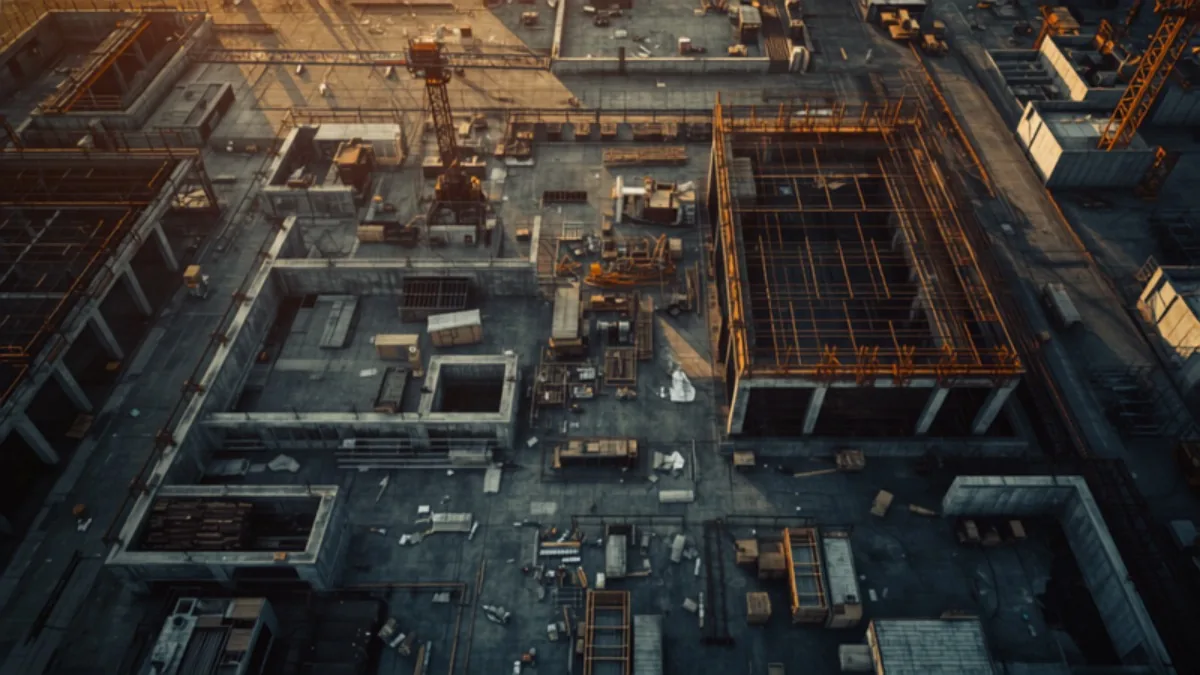
Field Notes: The Hospital Build's Hidden Document Problem
Walk a hospital construction site and you will count the cranes, the trades, the staged equipment. What you cannot see — and what quietly governs whether the project lands on time — is where the project's documents live. Because on a build this size, they do not live anywhere. They live everywhere, and that is the hidden problem.
A hospital is not one project. It is dozens of overlapping ones, stitched together: structural, mechanical, electrical, the specialized worlds of medical gas, imaging shielding, infection control, and equipment that arrives with its own integration drawings late in the game. Each of those worlds runs on its own documents, kept by its own vendor, in its own system, on its own clock. The owner sits at the center of this and is responsible for all of it — but holds a direct, current copy of almost none of it.
One project, many homes for the truth
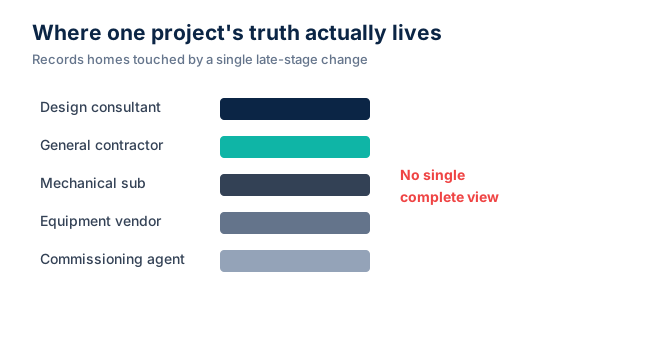
Consider a single late-stage change to a surgical suite. The design consultant updates the drawings. The general contractor logs the change order. The mechanical sub revises its shop drawings. The equipment vendor adjusts its integration specs. The commissioning agent updates its checklist. Five organizations just touched one decision, and they recorded it in five places, in five formats, on five different days. No one of them is wrong. But there is no single spot where you can stand and see the surgical suite's complete, current truth. To assemble it, someone has to go gather it — from five inboxes, five drives, and five people's memories.
That assembly cost is the hidden problem. It does not show up as a missing document, because usually nothing is missing — every piece exists, somewhere. It shows up as delay, as the days it takes to answer a question that should take minutes, and as the slow erosion of confidence that anyone actually knows the current state of the whole.
The owner needs a window, not another copy
The instinct is to demand that every vendor send everything to the owner, who then files a copy of it all. That just moves the swamp; now the owner has a vast drive full of point-in-time copies that are stale the moment they land. What the owner actually needs is not more copies but a window: a single place that shows the current state of each part of the build and who holds the authoritative record behind it, updated as the work moves rather than mailed after it.
This is the reality behind so much of what makes healthcare capital projects feel uniquely chaotic. The chaos is not in the concrete. It is in the structure of the information — many vendors, many sites, one fragile thread connecting them — and it is the part of the build that no walkthrough will ever reveal. The teams that deliver these projects calmly are not the ones with fewer vendors. They are the ones who decided early that one project would have one place to see its truth, and made every vendor's record reachable from there.
See how this plays out across the sectors we serve in where XNM-VISION is used.