A Document Control System People Actually Follow

Most document control systems don't fail because they're badly designed. They fail because following them is harder than ignoring them — so people quietly route around them, and within a month the 'system' is a folder nobody trusts and a process everyone has a private workaround for.
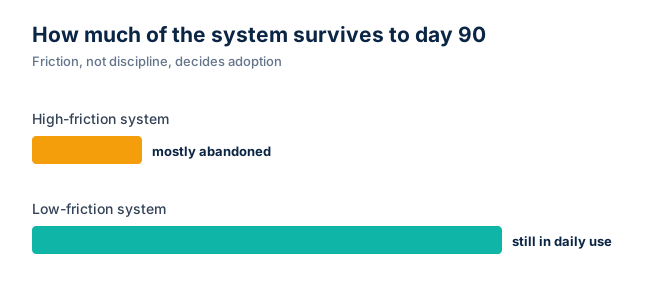
The real test of a system isn't its flowchart. It's whether a busy engineer at 4:45 on a Friday uses it, or just emails the file to get the thing done. If the shortcut beats the system even once, it'll beat it again — and the systems that survive all share one trait. It isn't discipline.
Why good systems die: friction always wins
Every extra step is a tax. A login, a naming rule to remember, a folder three levels deep, a form to fill before you can save — each one is small, and each one is paid grudgingly until the day someone is slammed. On that day they take the shortcut, because the shortcut is free and the system costs time they don't have. One shortcut becomes a habit; the habit becomes a shadow system; the shadow system becomes the real one. The official process didn't lose an argument. It lost a race against friction, and friction is always faster.
Design for the lazy path, not the disciplined one
Here's the trait the durable systems share: the right way is the easy way. Not the virtuous way, not the well-documented way — the easy one. If doing it correctly is also the path of least resistance, adoption takes care of itself and you never have to police anyone. So stop designing for the disciplined version of your team and design for the rushed, distracted, overloaded version. That's who actually shows up. A handful of principles get you most of the way there.
One obvious home. The current document lives in exactly one place everyone can find without asking. Two equally-official locations is two truths, which is none.
A name that sorts itself. A consistent pattern — project, document, date or version — so the current file announces itself. No 'final', no 'final_v2', no 'final_FINAL_use-this'.
Saving beats sending. Putting the new version in the right place must be easier than emailing it around. If it isn't, email wins and your system is already bypassed.
Status you can see. Current, draft, superseded — visible at a glance, so no one has to open a file to learn whether they should trust it.
Receipt, not broadcast. A change isn't 'communicated' because you sent it. It's communicated when the people who depend on it have acknowledged the new version.
Learnable in a minute. If onboarding the rule takes more than a paragraph, it's too complex to survive a busy week. Simplicity is what makes it stick.
Make the audit a by-product, not a project
When the system is followed because it's the easy path, something quiet and valuable happens: the audit trail builds itself. You're no longer reconstructing who approved what and when from memory and inboxes, because the act of working correctly already recorded it. 'Audit-ready' stops being a fire drill and becomes the resting state — not because anyone tried harder, but because the easy path and the correct path finally became the same path.
This is exactly the problem we built XNM-VISION to end — one place where the current version, who approved it, and who has it all live together. But even if you never touch our software, the rule underneath it will save you: make the right way the easy way, and your document control stops needing willpower to survive.
More field-tested practices like these in our Field Guide series.