The Record Is the Licence to Operate: Pipeline Integrity as an Evidence Discipline
A pipeline integrity manager does not get graded on intentions. The dig was either justified by the in-line inspection data, or it was not. The repair either traces back to a documented anomaly and an engineering assessment, or it floats in the file with no lineage. When the regulator comes asking, the difference between a confident answer and an anxious one is rarely the condition of the steel. It is the condition of the record.
That is the uncomfortable part of integrity management. The physical work - inspection runs, corrosion modelling, pressure testing, valve maintenance - generates a mountain of evidence that lives in a dozen systems and inboxes. The integrity is real. Proving it on demand is a separate discipline, and it is the one that fails first. A program can be technically sound and still expose its operator if the documentation cannot be assembled, dated, and defended when it matters.
Recent context
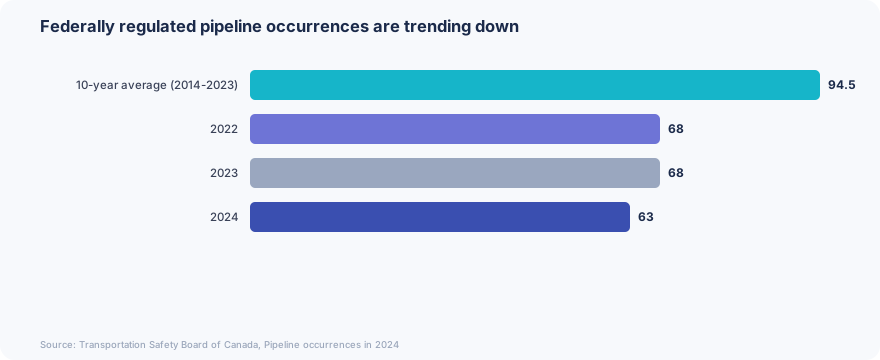
The encouraging news is that Canadian pipelines are getting safer. According to the Transportation Safety Board of Canada's 2024 pipeline occurrence statistics, federally regulated pipelines recorded 63 occurrences in 2024, down from 68 the prior two years and well below the 10-year average of 94.5. Product releases fell to 13 - the lowest figure ever reported. The TSB links the improvement, in part, to maturing integrity-management programs. But better outcomes raise the bar for proof, not lower it.
Why the record carries the licence
Under the Canada Energy Regulator's Onshore Pipeline Regulations, a company must develop, implement and maintain an integrity-management program that anticipates, prevents, manages and mitigates conditions affecting safety across the entire lifecycle - design through abandonment. When a defect exceeds CSA Z662 limits, the company must document the particulars, the likely cause, and the corrective action, and produce that documentation on request. The obligation is continuous and the evidentiary standard is exacting. The CER is also modernizing those regulations, with a pipeline-integrity topic heading into further engagement, so the documentation burden is being refined, not relaxed.
Read alongside the safety trend, the message is clear. The regulator credits improvement to programs it can audit. An audit is a request for evidence under time pressure: show the inspection that found this feature, the assessment that sized it, the decision that scheduled the response, and the proof the response was done. If those threads are scattered across SCADA exports, consultant reports, GIS layers and email, the answer comes late and incomplete - and a late, incomplete answer reads as a program weakness whether or not the pipe is sound.
How XNM helps
XNM exists to make that evidence trail retrievable. The XNM-Vision platform pulls a pipeline program's scattered records - inspection reports, anomaly assessments, repair packages, maintenance logs, regulatory correspondence and the audit trail behind every decision - into one auditable system, organized by asset and segment rather than by whoever happened to save the file. When the CER asks how a specific anomaly was managed, the chain from detection to closure is one query, not a week of archaeology. Because it organizes records you already produce rather than replacing your engineering systems, it deploys in days, not the months a full records overhaul usually consumes - so the next compliance cycle, not the one after, is when it pays off.
Practical takeaways
Treat documentation as part of the work, not after it. An inspection or repair is not complete until its record is filed, dated and linked to the asset it concerns. Build that into the workflow, not the year-end scramble.
Organize by asset, not by author. Records filed under a person, a vendor or a year fragment the moment people move on. A segment-based record survives staff turnover and ownership changes.
Keep the decision trail, not just the result. Regulators test reasoning. The assessment that sized an anomaly and the logic that scheduled the response are as important as the final action.
Rehearse the audit. Pick a recent anomaly and try to assemble its full history in an hour. The gaps you find are the gaps the regulator will find.
Make retrievability a metric. If your program's quality is judged on evidence, measure how fast and how completely you can produce it.
FAQ
Does a strong safety record reduce the documentation burden?
No. The regulator attributes improving safety to auditable programs, which means the documentation is the basis of the credit. A clean operating record still has to be proven, and the proof is the integrity-management file.
Isn't this just a job for our engineering data systems?
Engineering systems hold the technical data, but evidence for an audit also lives in reports, correspondence, assessments and approvals across many tools. The gap is rarely the raw data - it is assembling the connected story on demand, which is a records problem.
The bottom line
Canadian pipelines are safer than they have been in a decade, and the regulator credits the programs it can inspect. That makes the integrity record the operator's real licence to operate. The steel can be sound, but if the evidence cannot be produced - complete, dated and connected - the program is exposed. Integrity is an engineering achievement. Proving it is a records discipline, and it is the one worth getting right before the next audit, not during it.