Accountability Is the Grant: Why Records Decide a Charity's Next Dollar

A charity runs on trust, but it is funded on evidence. Donors and funders give because they believe in the mission - and they keep giving because the organization can show, credibly, that the last dollar did what it was meant to do. That second part is a records discipline. Every grant a charity receives comes with strings: a budget to track against, outcomes to report, and an expectation that when the funder asks where the money went, the answer is ready. Miss that, and the most mission-driven organization in the world starts to lose the funding that lets it do the mission at all.
The stakes are higher than they look because of how charities are funded. Government is the single largest source of charitable revenue in Canada, which means a large share of the sector's money arrives wrapped in public-accountability requirements - reporting, monitoring, and an audit trail that has to hold up. And when a charity grants money onward to partners or community groups, it inherits a further layer of accountability for how those funds are used. A small organization can find itself responsible for a record that would strain a much larger one. When that record lives in spreadsheets and a few people's inboxes, reporting season becomes a scramble, and a scramble is where funding relationships quietly fray.
Recent context
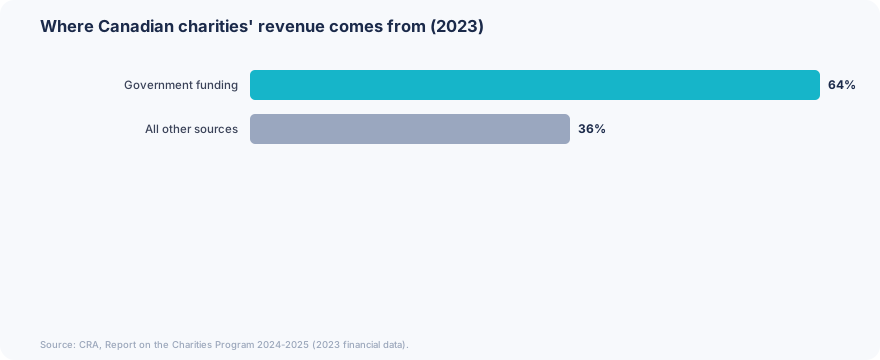
The dependence is striking. The CRA's Report on the Charities Program shows government providing roughly 64% of all charitable revenue across Canada's 86,000-plus registered charities - a sector handling close to $400 billion in annual revenue. Funded dollars on that scale come with reporting obligations on the same scale, and the organizations that meet them cleanly are the ones positioned to keep the funding flowing.
Granting onward multiplies the record
Accountability does not stop at the charity's own books. When a charity funds non-charities through 'qualifying disbursements,' Canadian rules require it to run a due-diligence review, put a written agreement in place, and monitor and report on how the funds are used - a real records obligation that, as Imagine Canada has noted, can weigh heaviest on the smallest organizations. Whether a charity is reporting upward to a funder or downward over money it has granted out, the same thing decides the outcome: a clean, traceable record of what was promised, what was spent, and what it achieved. The organization that can produce that on request keeps both its funders' trust and its eligibility for the next dollar.
How XNM helps
XNM helps non-profits and foundations hold the grant and program record in one auditable command centre - applications, budgets, agreements, receipts, outcomes and the reporting tied to each funder and each onward grant, kept current and ready. Where it helps, the XNM-Vision platform turns reporting from a year-end scramble into a byproduct of doing the work, and gives leadership a portfolio view across every grant the organization holds and every disbursement it has made. When a funder, the CRA, or the board asks where the money went and what it achieved, the answer already exists. And because it stands up in days rather than the months a records project usually takes, even a small team can carry the accountability of a much larger one.
Practical takeaways
Treat the record as the funding pipeline. The next grant depends on accounting for the last; a clean record is what keeps the money flowing.
Capture reporting as you go. If a grant requires outcomes and financial reporting, record them as the work happens - not in a year-end reconstruction.
Account for money you grant onward. Funding partners means inheriting their accountability; keep the due diligence, agreement and monitoring in one place.
Make the audit trail hold up. Public funding comes with public-accountability expectations; assume the CRA or a funder will ask, and be ready.
Give leadership a portfolio view. Across many grants and disbursements, you need one line of sight, not a folder per funder.
FAQ
We're a small charity with limited admin capacity. Is rigorous record-keeping realistic?
It is precisely the case for one system instead of many spreadsheets. A small team cannot afford to lose weeks reconstructing a grant report or, worse, a funder's trust. Capturing the record once, as the work happens, is what lets a lean organization meet large-organization accountability without adding staff to chase paper.
Our funders trust us - why invest in this now?
Because that trust is renewed every reporting cycle, and it is cheapest to protect before a deadline or an audit puts it to the test. A clean record is not a sign of distrust; it is what lets a good relationship survive a hard question and a funding decision go your way.
The bottom line
For a charity, accountability is not the price of funding - it is the path to the next round of it. When most of the sector's money arrives funded and reportable, and granting onward adds another layer, the record becomes the pipeline: clean, traceable, and ready when a funder asks. The organizations that keep doing the most good are the ones that can prove, on demand, exactly what the last dollar did.