When a Hospital Build Goes $4 Billion Over: The Records Problem Behind Capital Overruns

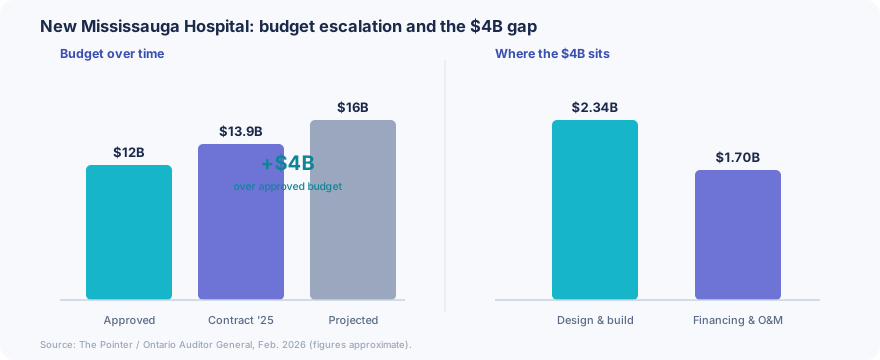
A single hospital project in Ontario is now tracking roughly $4 billion over the budget its own government approved. The new Mississauga Hospital - 22 storeys, about 950 beds, not slated to open until 2034 - has become the country's most visible example of a capital program outrunning its controls. It is tempting to read a number that large as a story about one project gone wrong. It is more useful to read it as a warning about what happens on any multi-year, multi-billion-dollar build when the records that are supposed to govern it fall behind the work.
Health authorities and hospital boards run some of the most document-intensive capital projects in the country: architectural drawings, construction contracts, change orders, clinical-equipment specifications, public-private agreements, ministry approvals, and 30-year maintenance schedules. When those records live across consultants' servers, email chains, and a patchwork of shared drives, the board loses the one thing it most needs to govern - a current, defensible line of sight from every dollar to the document that authorized it. Oversight becomes a matter of trust rather than evidence.
Recent context
The scale of the problem is now on the public record. The Pointer reported in February 2026 that the new Mississauga Hospital is tracking about $4 billion over the $12-billion budget Treasury Board approved - roughly $2.3 billion in design-and-construction overruns and $1.7 billion in added financing and 30-year maintenance costs - on a project whose construction has barely begun. Ontario's Auditor General first flagged the variance in a 2024 audit, with a follow-up due in late 2026.
What an overrun is actually made of
Megaproject overruns rarely arrive as one dramatic surprise. They accumulate - a change order here, a scope addition there, a financing assumption that shifts under a long timeline. Every one of those increments is a document and a decision. The question for any board is whether it can see the running total and trace each increment back to the choice that caused it, early enough to act. That matters far beyond one hospital: Ontario alone plans about $64 billion over the next decade for health infrastructure across more than 50 hospital projects and roughly 3,000 new beds. At that scale, small per-project control failures do not stay small - they compound across an entire portfolio.
How XNM helps
XNM helps health authorities and hospital boards bring the capital-project record into one auditable command centre - contracts, drawings, change orders, approvals, and the dollars they move, tied together and kept current. Where it helps, the XNM-Vision platform gives directors and trustees a portfolio view across every project, so the running total of scope changes is visible long before a year-end reckoning. When the Auditor General, the ministry, or the board's own finance committee asks what changed and who approved it, the answer already exists. And because it deploys in days rather than the many months a records overhaul usually takes, the control arrives while it can still change the outcome.
Practical takeaways
Tie every dollar to a document. A budget line you cannot trace to an approved change order is a control gap waiting to surface in an audit.
Track change orders as they happen. The running total of scope changes is your early-warning system; review it monthly, not at year-end.
Make the project audit-ready by default. Assume the Auditor General will ask, and keep the record in a state where the answer is already there.
Give the board one portfolio view. Trustees governing dozens of projects need a single line of sight, not dozens of status decks.
Keep the owner's record separate from the builder's. Consultants and contractors come and go; the institutional memory of the project must stay with the owner.
FAQ
Isn't a cost overrun just inflation and construction risk?
Some of it always is. But the part a board can control is visibility - knowing what changed, when, and on whose authority, early enough to respond. Inflation you manage; blind spots you cannot. Records are how you tell the two apart.
We use a public-private (P3/AFP) model. Does records control still matter?
Even more. Under a public-private agreement, the owner's leverage over a 30-year term rests on holding the partner to the documented deal. Your records are your contractual memory - and the moment you cannot find them, that leverage is gone.
The bottom line
A $4-billion variance is a governance story before it is a construction story. The hospital boards that keep control of their capital programs are the ones that keep control of their records - every drawing, contract, and change order in one place, current and defensible. A build is only as governable as the paper trail behind it.