The Tailings Dam Runs on Its Record: Why Zero-Failure Safety Is a Governance Discipline
A tailings dam almost never fails from a single bad day. It fails from a record that quietly went stale - a monitoring reading no one connected to the last one, a design assumption that was never revisited, a maintenance action that happened in someone's memory but not in the file. The structure holds back mine waste and water, sometimes for generations, and it is meant to hold forever. What keeps it standing is not only engineering; it is an unbroken, auditable record of what was designed, what was built, what is being measured, and who is accountable. For a mining company, tailings safety is a governance discipline wearing an engineer's hard hat.
That is why the modern standard for tailings is, read closely, a records standard. A tailings facility carries a design basis and a documented knowledge base, an operation-maintenance-surveillance (OMS) manual, instrumentation and monitoring data that has to be reviewed against defined triggers, emergency response plans, independent reviews, annual management reviews, and a named senior executive who is accountable for the facility. Every one of those is a record obligation as much as an engineering one. When the knowledge base is scattered, the monitoring trail has gaps, or the accountable person has changed three times without the file following, the facility does not become unsafe overnight - but the ability to prove it is safe, and to catch the drift before it matters, quietly erodes.
Recent context
The industry has put a hard date on this. CIM Magazine reported in November 2025 that ICMM members had to disclose the conformance status of every one of their tailings facilities by August 2025, and that across 836 member facilities, 67 percent reached full conformance with the Global Industry Standard on Tailings Management (GISTM) while 33 percent remained in partial conformance - with over 80 percent of 'extreme' or 'very high' consequence facilities in full conformance. The GISTM, launched in 2020 by ICMM, the UN Environment Programme, and the Principles for Responsible Investment, sets out six topic areas, fifteen principles, and seventy-seven auditable requirements across the full facility lifecycle. Auditable is the operative word: conformance is proven on the record, or it is not proven at all.
The standard is a records standard
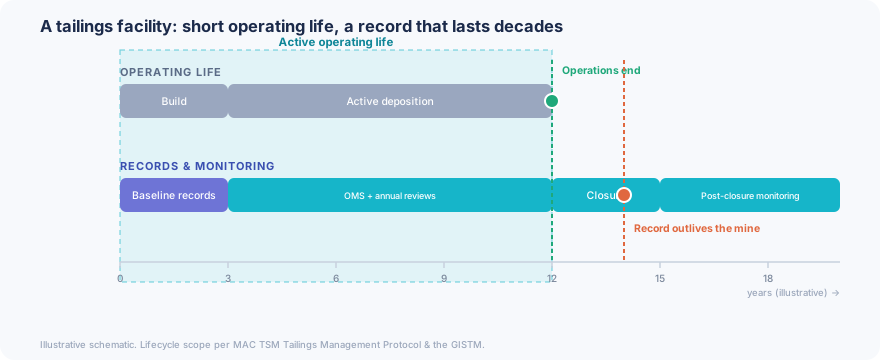
Strip the engineering vocabulary away and the requirement is governance you can evidence. In Canada, the Mining Association of Canada's Towards Sustainable Mining Tailings Management Protocol frames the same discipline around five performance indicators - a corporate tailings policy and commitment, clearly assigned accountability and responsibility, site-specific management systems and emergency preparedness, site-specific OMS manuals, and annual tailings management reviews - across the entire lifecycle from planning through closure and post-closure. None of that is a one-time deliverable. A tailings management review is only as good as the records it draws on; an OMS manual only protects the dam if it is current and followed; accountability only means something if the trail shows who decided what, and when. The safety case is a living record, continuously maintained, or it is a binder that describes a facility that no longer exists.
How XNM helps
XNM helps mining operators hold the full tailings record in one auditable command centre - the design basis and knowledge base, OMS manuals and their revisions, monitoring and inspection data, review reports, emergency plans, and the accountability trail behind every decision - organized by facility and kept current across a portfolio of sites. Where it helps, the XNM-Vision platform makes the current version of every critical document unmistakable, preserves the history behind it, and keeps the record in a state where conformance can be demonstrated on demand rather than reconstructed under scrutiny. When a board, an independent reviewer, or a regulator asks to see the evidence, it already exists in a defensible, time-stamped form. And because it stands up in days rather than the many months a records program usually takes, the discipline is in place before the next review cycle, not after the next finding.
Practical takeaways
Treat the knowledge base as a live asset, not an archive. A tailings facility's design basis and history have to be current and findable - a knowledge base you cannot assemble on demand is a governance gap, not a filing one.
Keep the monitoring trail unbroken and connected. A single reading means little; the value is in the continuous record measured against defined triggers, so a drift is caught while it is still small.
Make accountability provable, not just assigned. A named accountable executive matters only if the record shows who decided what and when - keep the decision trail with the facility, through every staffing change.
Keep the OMS manual current and version-controlled. An operations manual protects the dam only if the field is working from the live version; one authoritative set per facility ends the ambiguity.
Build for conformance you can demonstrate on demand. Auditable standards are proven on the record; keep the file in a state where a review meets evidence, not a scramble to reassemble it.
FAQ
Isn't tailings safety an engineering problem, not a records one?
It is both, and the record is the part that fails silently. Engineering sets the design; the record proves the facility still matches it - through monitoring, maintenance, reviews, and accountability. Most of what modern standards require is evidence you can produce, which is precisely why a strong engineering design with a weak record is still a governance risk.
We conform to the standard already. Why change how we manage the record?
Conformance is not a one-time state; it is maintained on a living record across a facility's whole life. The question is not whether you conformed at the last review, but whether you can demonstrate it at the next one without a reconstruction effort. A record kept current is the difference between proving conformance and scrambling to.
The bottom line
A tailings dam is one of the longest-lived and highest-consequence structures a company will ever own, and the standard that governs it is, at bottom, a demand for an unbroken, auditable record. The operators who meet it are not only the ones with the best engineering; they are the ones whose knowledge base, monitoring trail, and accountability were never in doubt. Zero catastrophic failures is the goal - and it is defended, every day, on the record.