The Site Instruction Given by Phone

The superintendent called at 7:40 on a Tuesday morning. Move the electrical room two metres east, he said - the geotech had flagged the footing. The crew had it re-framed by lunch. Four months later, when the owner asked why the room wasn't where the drawings put it, there was no call, no email, no note. Just two people remembering the same morning differently.
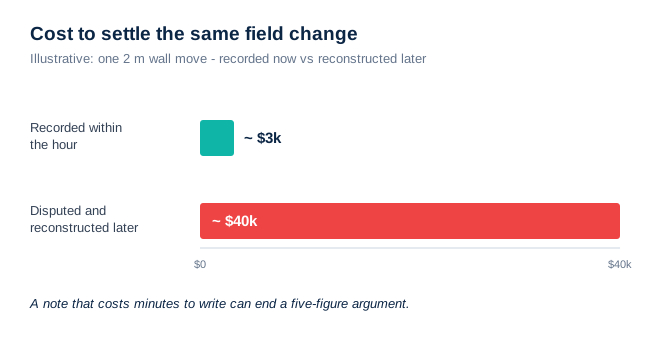
That two-metre shift cost roughly forty thousand dollars to untangle - not because moving a wall is expensive, but because nobody could say who authorized it. This is the quiet arithmetic of the verbal site instruction, and by the end of this you'll know exactly where the money leaks and how to close the gap in under an hour.
The instruction that never existed
On a live site, direction moves at the speed of talk. A super waves a hand, a foreman nods, a subtrade adjusts. Most of it is right, most of it is minor, and most of it never touches paper. That works fine - right up until one of those spoken directions turns out to be wrong, expensive, or disputed. Then the absence of a record stops being a convenience and becomes a liability.
The problem isn't that people lie. It's that memory is lossy and incentives diverge. Six weeks after the call, the superintendent remembers approving a minor field adjustment. The subtrade remembers being told to move a whole room and expects to be paid for it. Both are telling the truth as they recall it. Without a contemporaneous record, there's no tiebreaker - just the louder voice and the better lawyer.
Who pays when there's no record
Here's the rule that governs every disputed instruction: the cost lands on whoever can't prove what was said. If the subtrade can show a written direction, the owner pays for the change. If they can't, the subtrade eats it - or fights for it, which burns margin either way. A verbal instruction doesn't remove the cost of the change. It just makes the cost float until someone with a paper trail pins it down.
And the float is never free. Every undocumented direction becomes a small open question that has to be resolved later, under worse conditions - after the wall is closed, after the invoice is disputed, after the schedule has moved on. Reconstructing a decision always costs more than recording it would have. A good site instruction is cheap insurance against an expensive argument.
So what does a usable record actually contain? Not much - which is exactly why there's no excuse to skip it:
What was directed - the actual change, in one plain sentence, not 'per our conversation'
Who gave it and who received it - names, not just roles
When - date and time, because sequence decides who knew what
Why - the reason on the record, so the change reads as justified, not arbitrary
Cost and schedule impact, even if the honest answer today is 'to be confirmed'
Write it down within the hour
The fix is embarrassingly cheap. A site instruction doesn't need a form in triplicate; it needs to exist, in writing, close to the moment it was given. A two-line email sent the same hour - 'Confirming your 7:40 direction to move the electrical room 2 m east per geotech; pricing to follow' - converts a fragile memory into an authoritative record. The person who sends that email controls the story.
So make it a habit, not a policy. Every verbal direction that changes the work gets a written confirmation before the end of the day, ideally within the hour, while the words are still exact. You're not building a bureaucracy. You're building the one thing a dispute can't argue with: a note that existed before anyone had a reason to shade the truth.
A verbal instruction that vanishes is the same failure that hides in the lost change order and the approval nobody can find - it's the problem we built XNM-VISION to end, projects and their records in one place you can't lose. We keep pulling that threadthrough the field notes on the blog. Confirm the call in writing within the hour, and the dispute never gets a foothold.