How to Keep Drawings and As-Builts in Sync

On the first day of construction, your drawings are perfect. They describe a building that doesn't exist yet, in exact detail. Then the first pipe hits an unexpected rock, the first duct routes around a beam that sat two inches off, and the gap opens. By month three, the drawings describe one building and the field is quietly building another.
That gap - between what was drawn and what got built - is the as-built problem. Close it continuously and your as-builts are worth something: the next renovation, the warranty claim, the emergency shutoff all depend on them. Let it drift and you'll spend the last month of the job trying to remember fourteen months of small decisions. Here's how to keep the model and the field aligned without a heroic finish.
Why as-builts drift
As-builts don't drift because people are careless. They drift because construction is a running negotiation with reality. A conflict gets resolved at 2 p.m. on a Thursday by a foreman and a subtrade, in the field, correctly - and the drawing that should reflect it is on a server somewhere, not in anyone's hands. The change is real; the record of it is optional. Multiply that by a thousand small resolutions and the drawing set becomes a historical document, not a current one.
The cost of the drift stays invisible until you need the drawings to be true. The day a facilities team opens a wall to find a valve the as-builts don't show, or a future contractor prices a renovation off a set that's off by a room, the accumulated gap becomes a real number. You paid for accurate records; you're holding a well-organized guess.
The closeout scramble - and how to avoid it
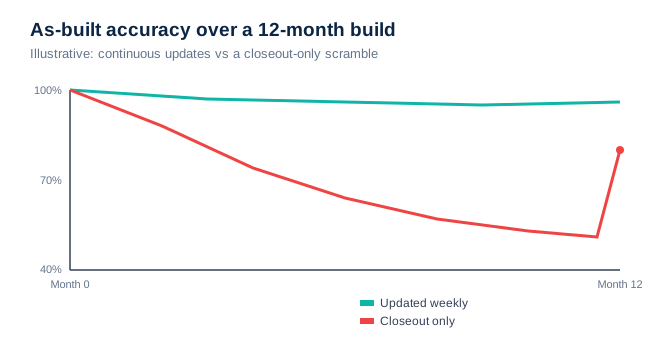
The default plan is to fix it all at the end: collect the red-lines, back them into the model, issue the as-builts at handover. In practice, the end of a job is the worst possible time to reconstruct its history. The people who made the decisions are demobilizing, the memories are stale, and the schedule pressure is at its peak. The scramble produces as-builts that are late, incomplete, and trusted by no one.
The alternative is a discipline of small, frequent updates. Four habits keep drawings and field aligned:
Red-line as you go - capture the change in the field the day it happens, on the drawing, not from memory a month later.
Keep one source of truth - everyone works from the same current set, so a change made once is visible to all, not copied into three diverging versions.
Do a weekly back-in - fold the week's red-lines into the master on a schedule, so the model is never more than a week behind the building.
Tie each change to its reason - link every as-built markup to the RFI, instruction, or conflict that caused it, so the record explains itself later.
Sync is a habit, not an event
The teams whose as-builts are actually trustworthy don't have better memories - they have a shorter loop between the change and the record. They treat the drawing set as a live instrument that must match the building this week, not a report they'll assemble later. Adopt that one belief and the closeout scramble simply disappears, because there's nothing left to reconstruct. The drawings are already true, because you never let them stop being true.
Keeping the model and the field aligned is the same discipline that keeps a budget from splitting in two and a change log from going dark - the small, frequent update beats the heroic reconstruction every time. There's more of that thinkingacross the field guide on the blog. Update the drawing the day the field changes, and handover stops being a scramble.