Field Notes: Real Estate Development's Entitlement Maze

You bought the land. The cheque cleared, the title is yours, the site is real dirt you can stand on. And you still can't put a shovel in it. Between owning a parcel and being allowed to build on it lies a stretch of process that most people outside development never see - and it kills more projects than any construction risk ever will.
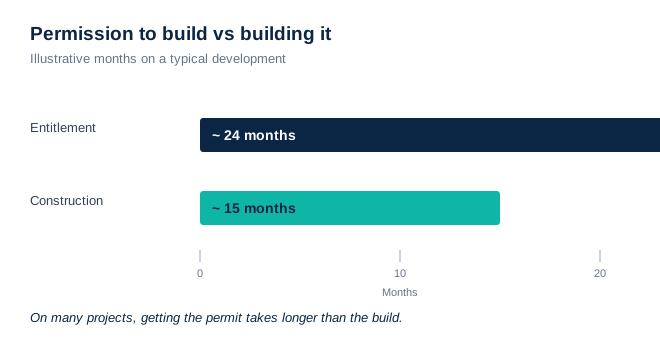
That stretch is called entitlement: the sequence of approvals that turns 'I own this' into 'I'm permitted to build this.' It's almost entirely paper, it runs on the municipality's clock rather than yours, and every month it takes is a month you're paying to hold land you can't use. Here's the maze, why deals die in it, and what separates the developers who get through from the ones who stall.
The paper path from dirt to permit
Entitlement isn't one approval; it's a stacked sequence, and each layer can send you back a step. In broad strokes it runs through: confirming what the land is zoned to allow, and applying to rezone if your project needs more than the current rules permit; official-plan or policy amendments if the use isn't contemplated at all; variances for the specifics the zoning won't quite fit; environmental and servicing studies proving the site can carry the project - water, sewer, traffic, stormwater, sometimes contamination; and finally the development permit and building permit that actually let you start.
None of these move in parallel as cleanly as you'd like. A servicing study can trigger a design change that reopens a variance. A rezoning can attract public opposition that adds months of hearings. Each layer has its own reviewers, its own queue, and its own power to say 'resubmit.' The paper path is less a straight line than a board game with a lot of 'go back three spaces' squares.
Where deals die
Deals rarely die because the answer is no. They die because the answer is slow, and the holding costs don't wait. Land carries a cost every month you own it - financing, taxes, sometimes an interim use to cover the carry - and that meter runs at full speed while your application sits in a review queue. A pro forma that pencils at a twelve-month entitlement turns underwater at twenty-four, and nobody decided that. The calendar decided it.
The projects that survive the maze tend to share a few habits:
They front-load the studies - environmental, traffic, servicing - before submitting, so reviewers have fewer reasons to bounce it back.
They read the political room early, because a rezoning is decided by people who answer to neighbours, not just to planners.
They keep every submission, comment, and response in one traceable record, so the fifth resubmission isn't starting from memory.
They budget the holding cost honestly, assuming the process takes longer than the optimistic case.
The maze rewards the organized
The entitlement maze isn't a test of vision; it's a test of stamina and record-keeping. The developer who tracks every study, comment, and resubmission as a living file moves faster through the queue than the one reassembling the story each time a reviewer asks a question. Treat entitlement as the real project - because until the permit issues, it is the project - and budget the patience the calendar is going to demand.
The paper path from land to permit is the same records problem that shows up on every capital project - the teams who keep a clean, traceable file simply move faster than the ones working from memory. There are more field notes like thison the blog. Front-load the studies and track every submission, and the maze gets a lot shorter.