One Chart: Why Status Meetings Run Long

The status meeting was booked for two hours. It used all two. And when everyone filed out, the honest question was: what did we actually decide? Half the room could name one thing. The other half wasn't sure. The meeting ran long not because people talked too much, but because it spent most of its time doing a job it was never meant to do.
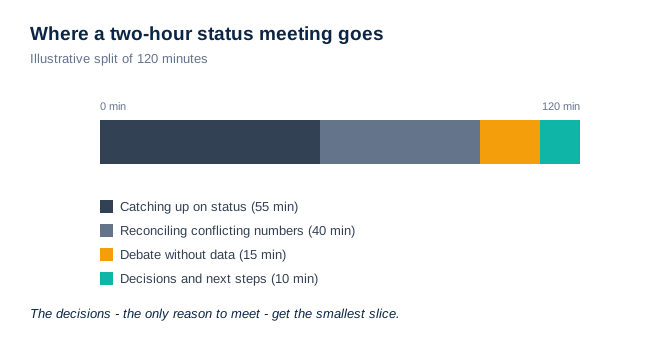
Here's the claim, and the chart below makes it plain: a status meeting runs long because most of the room's time goes to reconstructing what happened, not deciding what's next. Fix that, and a two-hour meeting becomes forty minutes - not by talking faster, but by walking in already knowing the status.
Where the two hours actually go
Watch a typical status meeting closely and you can time the segments. A large chunk goes to status recall - people narrating where things stand, catching each other up, correcting each other's picture of reality. Another chunk goes to reconciling conflicting information: your number says one thing, mine says another, whose is right. Only a thin slice, usually near the end when everyone's tired, goes to the thing the meeting exists for - making decisions and assigning the next move.
The ratio is the whole problem. When most of the hour is spent establishing a shared version of the present, there's barely any left for the future. And because the recall happens live, out loud, it's the slowest possible way to distribute information - one person talking while everyone else waits. You've turned a document problem into a meeting problem, and meetings are expensive by the head-hour.
The fix is upstream of the meeting
You can't fix a long status meeting inside the meeting. The cause is upstream: the status wasn't current and shared before people walked in, so the room had to build it from scratch. When the record is live - when everyone can see the same current picture before the meeting starts - the recall segment collapses to near zero. There's nothing to catch up on. The reconciliation segment collapses too, because there's one set of numbers, not five.
What's left is the part that actually needs humans in a room: judgment. The calls that require debate, the tradeoffs, someone with authority deciding. That meeting is short, because it does one thing. And it feels productive, because for once it was.
Walk in knowing
So the next time a status meeting runs long, don't shorten the agenda - move the status out of the meeting. Make the current picture visible to everyone beforehand, from one source, and let the meeting do only what a meeting is good for: deciding. The two hours you get back every week were never a scheduling problem. They were a records problem wearing a scheduling costume.
A meeting that runs long because nobody arrived with a shared picture is the same records gap that stretches an audit and splits a budget in two - the cure is always a live, single source of truth. We keep coming back to that ideaacross the blog. Put the status where everyone can see it before the meeting, and the meeting gets its time back.