Governance Is Just Records With Consequences

Governance is a word that makes people's eyes glaze. It sounds like committees, frameworks, and someone's forty-slide deck. But strip all of that away and governance is something simple enough to fit on an index card: a decision that was written down, and that actually binds what happens next. That's it. Everything else is decoration.
This matters because most organizations think they have governance because they have policies and meetings. What they actually have is a pile of decisions - some recorded, some not, some enforced, most not. By the end of this you'll be able to tell real governance from the costume version with two questions.
Decisions that bind
Start with the first half: documented decisions. A decision that no one wrote down isn't governance; it's a memory, and memories diverge. The board approved the budget - where's the record of what, exactly, they approved, and on what terms? If the answer is 'everyone knows,' you don't have governance, you have folklore. The written decision is what makes it checkable, transferable, and survivable when the people who were in the room leave.
This is why the record isn't bureaucratic overhead - it's the thing itself. A decision that exists only in people's heads can't be audited, can't be inherited by the next team, and can't settle a dispute. Write it down and it becomes an asset the organization owns, rather than a story a few people happen to carry.
The consequence part
Now the second half, the one most 'governance' fails: consequences. A documented decision that nothing enforces is just a nicely filed opinion. Real governance binds - it says this is the spending limit, and above it you need this approval, and if you skip that approval, here's what happens. The teeth are the point. A policy everyone quietly ignores isn't governance; it's decoration that lets an organization feel governed while it actually operates on vibes.
So here are the two questions that separate governance from its costume:
Is the decision written down, specifically enough that someone who wasn't in the room could apply it?
Does anything actually happen when it's ignored - or is it enforced only when it's convenient?
If a rule is both recorded and enforced, it's governance. If it's recorded but never enforced, it's a suggestion. If it's enforced but never recorded, it's a personality - and it walks out the door the day that person does. Only the first survives a leadership change, an audit, or a hard year.
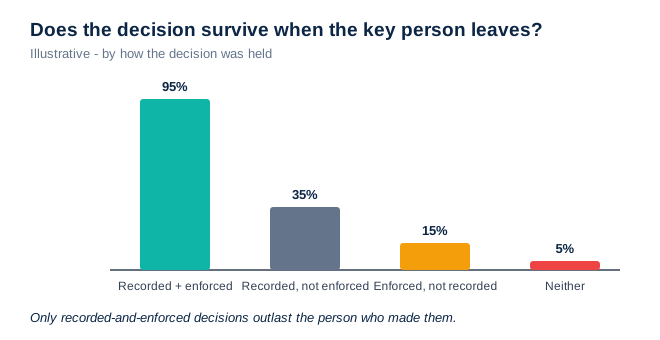
Governance you can actually see
The practical takeaway is smaller than the word suggests. You don't need a bigger framework; you need your real decisions written down in a place that outlives the meeting, and a consequence attached to the ones that matter. The test is brutally simple: if the key person left tomorrow, would the decision still stand and still bind? If not, you don't have governance yet. You have them - and people leave.
Governance as documented, binding decisions is exactly the gap XNM-VISION was built to close - decisions and their records in one auditable place, so a rule survives the person who made it. But even if you never touch our software, the two-question test will tell you where you actually stand. We keep pulling that threadacross the blog. Write the decision down, attach a consequence, and you've built governance you can point to.