The Schedule Everyone Trusted but No One Owned

The schedule on the trailer wall said steel erection started Monday. It had said that for five weeks. Steel had not started.
Nobody lied. Four people were keeping that schedule honest, each in their own file, and each assumed one of the others was posting the truth. The overrun did not begin when the steel slipped. It began months earlier, on the quiet day the schedule got its fourth editor and lost its last owner.
Four people maintained it. That was the problem.
On paper the project was well run. A mid-size civic build, a scheduler on contract, an experienced project manager, a site superintendent who had built half the town, and an owner's representative who reported upward every month. The master schedule lived in a shared folder. Anyone could open it. Anyone could save over it.
Which is exactly why nobody did. Saving over a file four other people rely on feels reckless, so everyone did the polite thing and kept a working copy instead. By month four there were four schedules. Each one was defensible. Each was current in the way its keeper needed it to be current. None of them was the project.
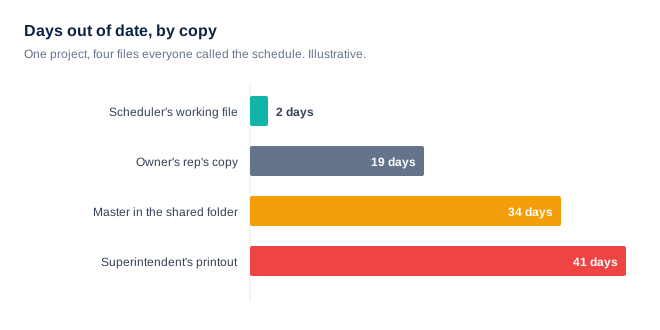
The scheduler's working file. Updated weekly, genuinely accurate, and sitting on a consultant's laptop where nobody thought to look.
The master in the shared folder. The one quoted in every meeting, last truly updated the week the foundations were signed off.
The owner's rep's copy. Annotated for reporting upward, with milestone dates rounded to the nearest comfortable month.
The superintendent's printout. Pinned to the trailer wall, corrected in pencil, and the only version the crews ever actually saw.
The steel date slipped in the scheduler's file in week nine. It slipped on the trailer wall in week eleven, in pencil. It never slipped in the shared folder at all, which is why the owner's monthly report said the project was on programme until week fourteen, when someone finally walked the site and looked up.
The question nobody could answer
When the review came, it did not ask for a critical path analysis. It asked one question: who updates this, and when? Four people gave four answers, and every one of them contained the word usually.
That is the tell. A schedule with four editors and no keeper is not a plan. It is a rumour with a Gantt chart attached. It still gets read, still gets quoted, still gets printed and pinned to a wall. But nothing in it is a commitment, because a commitment needs somebody whose name is on it.
Notice what did not fail here. The software worked. The scheduler was good at the job. Everyone was competent, everyone was busy, and everyone was acting reasonably given what they could see. That is what makes this failure mode so durable: there is no villain to fire and no obvious moment where someone did the wrong thing.
Name a keeper before you name a date
You do not fix this with better software, and you certainly do not fix it with another weekly meeting. You fix it by naming one person. One keeper. One file that is the schedule, and everything else is a copy that has no standing. Changes go to the keeper. The keeper posts a dated update on a fixed cadence, and posts it even when nothing has moved, because no change this week is information too.
It costs about twenty minutes a week. Set against that: the slip itself was survivable. What was not survivable was the eleven weeks nobody spent reacting to it, because the version of reality that reached the people with money in the room was the one nobody had touched since the foundations went in.
The same pattern hides wherever a document has many readers and no keeper. Budgets. Risk registers. Drawing sets. If it made you think of a file on your own project, the rest of the field notes are worth an hour of your week.