The Board-Reporting Pack That Writes Itself
Nine days. That is how long it took one executive director to assemble a forty-page board pack. The board read it in about twenty minutes, asked two questions the pack had already answered, and approved everything.
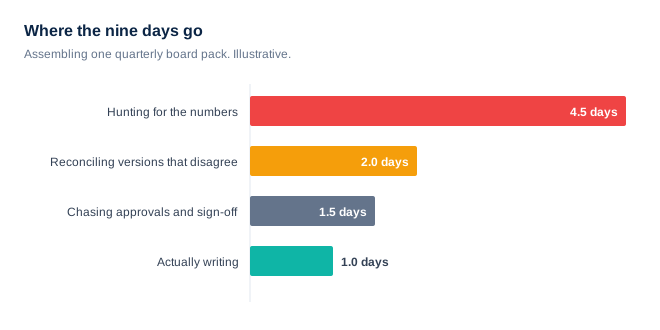
She did that four times a year. Thirty-six days a year, gone. And here is the part worth sitting with: almost none of those nine days was spent writing. By the end of this you will know exactly where they went, and why hiring a better writer would not have saved a single one.
The nine days are not writing. They are archaeology.
Watch closely and the work decomposes into something uncomfortable. Four and a half days hunting for numbers that already exist somewhere: a grant balance in an email, a headcount in a spreadsheet, a programme total the finance volunteer keeps in a file only she has. Two days reconciling versions that disagree, because the number in the funder report and the number in the accounts were both right in their own way. A day and a half chasing approvals for things already decided. And then, at the very end, one day of actual writing.
That is the whole problem in one sentence: the pack takes nine days because the organization cannot answer questions about itself without a search party.
Make the pack a by-product, not a project
The fix is not a template. Templates are what you reach for when you already have the facts. The fix is to run the organization so the pack is the natural residue of a quarter that was recorded as it happened. Six habits get you most of the way:
Decide the spine once. Agree the pack's sections with the board and then do not renegotiate them each quarter. A stable spine turns a blank page into a set of slots.
Give every recurring number exactly one home. One place where headcount lives. One place for the grant balance. If a number appears in two places, one of them is a copy, and it will be the wrong one within a month.
Log decisions where they are made. Two lines in the minutes at the moment of the decision beats two hours of reconstruction in month three. Record what was decided and what it was based on.
Keep the risk register rolling, not quarterly. A register you touch only before a board meeting is a work of fiction written under deadline. Update it when the risk changes; the board sees a live picture instead of a fresh invention.
Write the narrative last, and keep it short. If the numbers assemble themselves, the narrative is the only thing that needs a human. Two pages of honest interpretation beats forty pages of restated tables.
Version the pack; do not rebuild it. Last quarter's pack is this quarter's starting point. Rebuilding from zero every time is how the spine drifts and how the archaeology creeps back in.
None of that is sophisticated. It is the unglamorous discipline of putting facts where they can be found by someone who is not you, on the day they were true.
What good looks like: the two-hour pack
An organization with these habits produces a board pack in an afternoon. The recurring numbers are pulled from their one home. The decision log becomes the decisions section, almost verbatim. The risk register is already current. What remains is the part that actually deserves an executive director's judgement: what does this quarter mean, and what should the board do about it?
This is the chaos we built XNM-VISION to end, by keeping the record and the reporting in one place so the pack falls out of the work. But the honest truth is that the six habits above will cut your nine days to two whether you ever touch our software or not. The habits are the thing. The tool just stops you from drifting off them.
The deeper version of this argument is that reporting is not a communication problem at all, it is a records problem wearing a communications costume. The rest of the field guides pick that thread up where this one leaves off.