Records Are How Small Teams Punch Above Their Weight

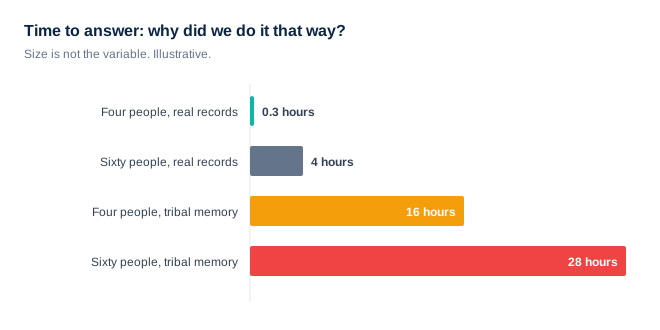
A four-person firm beat a sixty-person firm to a contract award. Not on price. They were not the cheapest and they did not pretend to be.
They won because when the evaluation committee asked why a similar project three years earlier had changed approach halfway through, they answered in about a minute, with the decision, the date, the reasoning, and what it cost. The sixty-person firm said they would follow up. The advantage was not talent and it was not hunger. By the end of this you will know exactly what it was, and why it is the only advantage that gets stronger as you get busier.
Big teams buy memory with headcount
Large organizations have a hidden luxury: they can afford to lose things. Not because they are wasteful, but because scale itself is a form of insurance. When nobody can find the decision, there is a person whose job is to find it. When the project manager leaves, three people remember roughly what happened. When the file is a swamp, an analyst can be assigned to wade through it for a fortnight.
None of this is written down as a strategy. It is just what headcount buys you: memory, redundancy, and slack, purchased at a price nobody itemizes. Which is precisely why big firms so often have genuinely worse records than small ones and do not notice. Bad records are survivable when you can throw bodies at the search.
Small teams have to build it instead
A four-person team has no slack to spend. There is no analyst to assign. If your one project manager cannot answer the question, the team cannot answer the question, and the client hears the sentence that quietly loses work: we will get back to you.
So a small team faces a choice a big team never has to make. Either you carry the memory in four heads, which works beautifully right up until you get busy, or you build a record that answers without you. The trap is that the first option feels faster every single day, and only fails on the days that matter most.
Three things that actually compound
Not everything you write down compounds. Most of it is landfill. Three things are worth the discipline:
Decisions with their reasons. The decision alone ages badly, because the reasoning is what tells a future reader whether the decision still applies. Anyone can find out what you did; only the record tells them why.
One home per fact. Every recurring number, date, and commitment has exactly one place it lives. The moment it has two, you have a reconciliation problem instead of a fact.
Findable by a stranger. The real test is not whether you can find it. It is whether someone who was not in the room can, without asking you. If it needs your narration, it is not a record. It is a souvenir.
Notice the shape of the advantage. Tribal memory degrades exactly when you get busy, because busy is when nobody has time to explain anything. A record does the reverse: the busier you are, the more often it answers on your behalf, and the more the discipline pays back. That asymmetry is the entire argument.
The turn
This is the chaos we built XNM-VISION to end, keeping the project and its record in one auditable place so a small team can answer like a large one. But take the honest version with you regardless: the four-person firm did not win because of software. They won because three years earlier, somebody spent five minutes writing down why they changed course, on the day it was still fresh, for a reader they would never meet.
That is the whole trick, and it is available to you this afternoon. Being small is not the disadvantage. Being unable to remember why you did what you did is the disadvantage, and it is the one thing you can fix without hiring anyone.
If you are the smallest firm in the room and want the rest of the argument, the other essays work through what a record is actually for, and why the answer is almost never filing.