Field Notes: Non-Profit Boards and the Accountability Record
Every person in the room means well. That is the strange thing about a struggling non-profit board: you cannot fix it by finding better people, because the people are already good. They volunteered.
Here is the claim this piece rests on. The board that asks the most questions is not the most engaged board. Often it is the least informed. Stay with that, because by the end you will see why it is a records problem rather than a personality problem, and why the fix is smaller than you think.
Two failure modes, one root cause
The first mode is the rubber stamp. The pack arrives on Thursday for a Monday meeting. It is forty pages, mostly tables, and no director can independently check a single number in it. So they do the only rational thing available: they trust the executive director and approve. This is usually described as a disengaged board. It is not. It is a board with no basis for judgement, behaving sensibly.
The second mode looks like the opposite. The board that questions everything, reopens settled matters, and wants to see the invoices. This gets described as a meddling board, or a trust problem. But watch what they are actually doing: reconstructing, live and out loud, a picture the record should have handed them in advance. They are not micromanaging out of temperament. They are doing archaeology in a meeting room because nobody gave them a record.
Same root. In both cases the board has no independent basis for judgement, so it either defers completely or interrogates endlessly. Those are the only two moves available to people who are accountable for something they cannot see.
What the accountability record actually is
It is smaller and duller than the phrase suggests. It is not a governance framework or a policy binder. In practice it is five things that answer, without a meeting, what the board is on the hook for:
Minutes that record the decision and the basis for it, not just the motion and the vote.
A register of what the board delegated, to whom, and within what limits.
The recurring numbers, each with one named source, so nobody argues about which figure is real.
Conflict declarations, kept current rather than recited annually.
A follow-up list where every item has a name and a date attached to it.
That is it. Notice that every item exists to answer a question a director would otherwise have to ask out loud, in a meeting, using time that could have gone to actual judgement.
The smallest fix that works
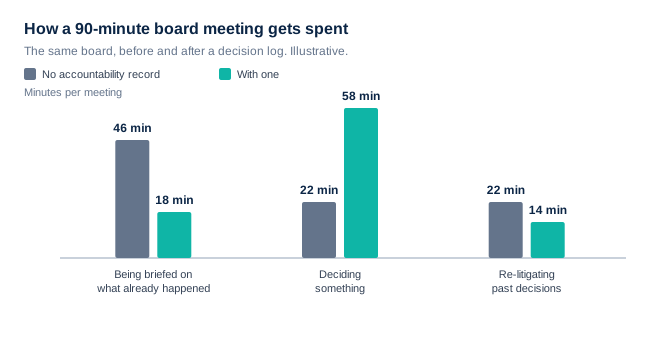
If you only do one thing, keep a decision log. One line per decision: what was decided, when, on what basis, and who carries it. It takes a minute at the time and it removes the single most expensive activity in a board meeting, which is re-litigating a decision nobody can quite remember making.
The shift it produces has a name worth borrowing: from default management to mutual accountability. A board with a record stops being either a stamp or an inquisition. It can ask a hard question in eight minutes instead of forty because it already knows what happened, and the executive director stops experiencing scrutiny as an ambush, because the answers were written down before anyone thought to ask.
That is the quiet trade at the heart of governance. Directors get something to judge against, and staff get to stop defending their memory. Both sides win, which is rare enough to be worth the minute a decision log costs.
Boards are not the only place this pattern appears. Any group accountable for work it cannot see behaves the same way. The other field notes follow the same problem into rooms that look nothing like a boardroom.