The Rate Base Is a Record: Why a Utility's Capital Plan Is Only as Good as Its Files
A regulated electric or gas utility does not simply spend money and pass the bill to customers. It invests capital - poles, wires, substations, pipelines, meters, control systems - and then asks a regulator for permission to earn a return on that investment. The value the regulator accepts is the rate base, and it is the single most important number in the business. But the rate base is not a spending total. It is an evidentiary claim: every dollar in it has to be shown to be prudently incurred, actually in service, and used and useful to the customers who pay for it. In that sense the rate base is a record before it is a number.
That distinction is about to matter more than it has in a generation. Canadian utilities are entering the heaviest capital cycle in decades - to electrify transportation and buildings, to harden the grid against extreme weather, and to connect new load and new generation. A capital program of that scale is only bankable if the documentation underneath it is complete and current: the engineering justification for each project, the procurement trail, the in-service dates, the change orders, and the cost support that ties a dollar spent to an asset serving customers. When those records are scattered across project teams, contractors, and aging spreadsheets, a utility risks the worst outcome in the business - spending the capital and then failing to fully recover it because it cannot prove the spend to the regulator's standard.
Recent context
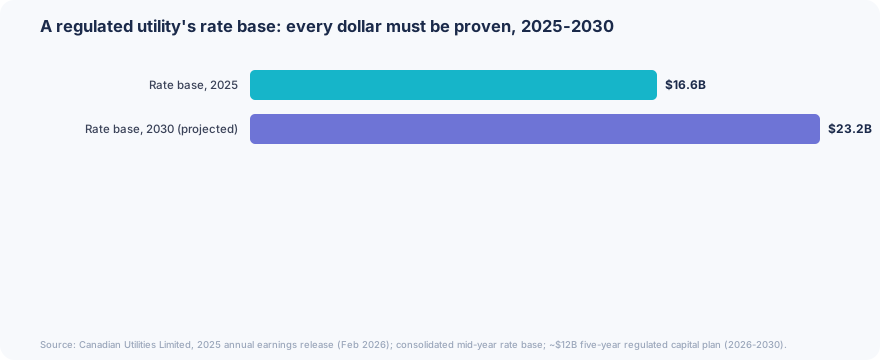
The scale is now on the record. Canadian Utilities reported in February 2026 a regulated capital plan of roughly $12 billion over 2026 to 2030, expected to lift its consolidated mid-year rate base from $16.6 billion in 2025 to a projected $23.2 billion by 2030 - a 6.9% compound annual growth rate. Utilities across the country are publishing capital plans in the same shape, driven by customer growth, reliability, and resilience. Behind each of those headline numbers sits a filing obligation: the company must justify the investment, and a regulator - and ratepayer intervenors - will test it.
The rate base is an evidentiary claim, not a spending total
Regulators do not accept capital at face value. Utility commissions test whether spending was prudent at the time the decision was made and whether the asset is genuinely used and useful. A dollar that fails either test can be disallowed - excluded from the rate base - and a disallowed dollar is a permanent loss to the utility's owners, not a timing difference. The defence against a disallowance is not an argument; it is a file. The engineering study that supported the project, the competitive procurement that set the price, the record of options considered and rejected, the in-service documentation, and the change history all have to be producible on demand, sometimes years after the work was done. A utility that can assemble that record quickly protects its return; one that reconstructs it from inboxes under a deadline invites the very disallowance it fears. The same discipline pays off in service quality and safety proceedings, where the question is again what you did, when, and how you can show it.
How XNM helps
XNM helps utilities pull the capital and asset record into one auditable command centre - project justifications, procurement files, contracts and change orders, in-service and commissioning records, inspection and maintenance histories, and the regulatory filings they feed, organized by asset and by project and kept current. Where it helps, the XNM-Vision platform gives a CFO or regulatory lead a single line of sight from a dollar of spend to the asset it created and the filing it supports, so the rate-base case is built on evidence rather than assembled in a scramble before a hearing. When a commission or an intervenor asks why this project, why this cost, and when it went into service, the answer already exists in a defensible form. And because it stands up in days rather than the many months a records overhaul usually takes, the visibility arrives in time to support the next rate application, not the one after it.
Practical takeaways
Treat the capital file as part of the asset. An asset you cannot document to the regulator's standard is worth less than one you can; build the record as you build the asset, not after.
Keep the prudence trail, not just the invoice. Regulators test the decision, so the options considered, the procurement, and the justification matter as much as the final cost - keep them together.
Tie every dollar to an in-service date. Used and useful is a test of timing; the record has to show when the asset actually started serving customers, not just when it was paid for.
Make the file producible on demand. A disallowance risk lives for years after closeout; keep each project's record complete and instantly retrievable long after the crews leave.
Build the rate case from the record, not for it. If the filing is assembled from scratch every cycle, gaps creep in - a living capital record turns each rate application into a query, not a project.
FAQ
Our finance system already tracks capital spend. Isn't that enough?
A ledger tells the regulator how much was spent, not why it was prudent or when it went into service. Prudence and used-and-useful are the tests that decide what enters the rate base, and they turn on engineering justification, procurement, and commissioning records that a general ledger does not hold. The value is in tying the dollar to the evidence behind it, in one place a regulator will accept.
We rarely see a disallowance. Why invest in the record now?
Disallowances are rare precisely because well-run utilities can produce the file when challenged; the record is the reason the risk stays low. As capital programs grow, the exposure grows with them, and the cost of a thin file is highest exactly when the spend is largest. Building the record now is cheaper than defending a gap later.
The bottom line
For a regulated utility, the rate base is the business, and the rate base is a record before it is a number. A multi-billion-dollar capital cycle is also a multi-billion-dollar documentation obligation - and the utilities that recover their investment in full will be the ones whose files were never in doubt. You earn a return on the capital you can prove, and proving it is a discipline you build one governed record at a time.