The Procurement File That Failed the Probe
The contract was awarded cleanly. The winning bid was, on the merits, genuinely the best one. And the file still failed the audit — because in public procurement, a fair process you cannot prove is treated as identical to one that never happened.
The team was blindsided, and you can understand why. They had done everything right: posted the opportunity, taken questions, scored the bids, picked the strongest. They knew they had run a fair competition. That knowledge was exactly the problem. They had quietly assumed that doing it right and being able to show it were the same act. They are not. The auditor never saw the fair process. The auditor saw the file — and the file could not stand up on its own.
The audit does not ask what you decided. It asks what you can show.
An auditor was not in the room when the evaluators debated. They reconstruct the entire procurement from documents alone. If the reasoning happened in a hallway, a phone call, or a thread that got cleaned out of someone's inbox, then as far as the record is concerned it did not happen. The question is never "was this fair?" The question is "can this file demonstrate, without anyone in the room to narrate it, that this was fair?" Those are different tests, and public bodies fail the second one constantly while passing the first.
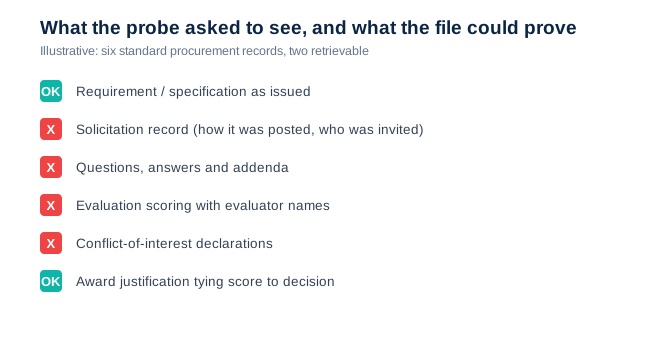
A defensible procurement file has to answer six questions on its own. When the probe arrived, here is what it wanted to see:
The requirement as issued. The specification or scope that actually went out, in the version bidders responded to — not a later, tidied copy.
The solicitation record. How the opportunity was posted, where, for how long, and who was invited, so no one can allege it was quietly steered.
Questions, answers and addenda. Everything issued to bidders during the open period, proving they all competed on the same information.
The evaluation, with names. The scoring sheets, the criteria, and which evaluator gave which score — the actual basis for the ranking.
Conflict declarations. Signed statements from each evaluator that they had no interest in the outcome, dated before the evaluation.
The award justification. The document that ties the winning score to the decision, so the award is a conclusion, not an assertion.
The file could produce two of the six. The scope was there and the award memo was there. Everything in between had leaked out of the record: the scoring sheets were on an evaluator's personal drive, the conflict declarations had been made verbally in a kickoff meeting, and the addenda had been emailed to bidders and never filed anywhere central. Nothing was hidden and nothing was corrupt. It was simply unprovable — and unprovable is the finding.
The fix is boring, which is exactly why it works
The cure is not a better audit response. By the time the auditor is asking, the file is already whatever it is. The cure is to build the file as the procurement happens, so that each step writes itself into one place at the moment it occurs. The addendum goes to bidders and into the file in the same action. The evaluators sign their conflict declarations into the record before they see a single bid. The scoring sheets are completed in the file, not on a laptop. Nobody has to remember to assemble anything later, because there is no later — the file is finished when the procurement is.
There is a one-line rule worth taping to the wall of every procurement office: if it is not in the file, it did not happen. Not "it probably happened." Did not happen — because that is precisely how an auditor, a losing bidder's lawyer, or a journalist with a records request will read it. Treat the file as the event itself, and you never have to reconstruct anything under pressure.
This is the exact problem we built XNM-VISION to end: a procurement whose every step — solicitation, addenda, scoring, declarations, award — lands in one auditable place as it happens, instead of scattered across inboxes and drives. But even if you never touch our software, the rule earns its keep on its own. Run your next competition as though a skeptical auditor will read only the file, and you will build a file that survives one.
The next time you close a procurement, ask the uncomfortable question first: if you handed the file to a stranger today, could they prove the process was fair without a single word from you? More field stories on records and public accountability are published every week on the XNM blog.