Field Notes: The Law Firm Matter File as a Capital Asset

When a senior partner leaves a firm, the clients do not usually walk out the door with them. What walks out is quieter and far more expensive: everything that partner carried in their head about each matter and never wrote down. The strategy behind a settlement posture. The reason a clause was drafted the way it was. The client's real, unstated priority. That knowledge was the most valuable thing the firm owned — and most firms let it leave without noticing.
Here is the reframe worth sitting with, because it changes how you run a practice: the matter file is not overhead. It is the asset. Firms tend to treat file management as a compliance chore — something risk management nags about, something you tidy before an audit. But the matter file is the durable, transferable form of a lawyer's judgment. Treat it that way and a firm becomes more valuable per lawyer, more resilient to turnover, and far harder to disrupt. The firms that understand this are worth more than the ones that do not, and it is not close.
What a client is actually paying for
Strip a legal engagement down to its core and the client is not buying hours. They are buying judgment — applied, preserved, and retrievable when they need it again. A client who calls two years after a deal closes does not want to hear that the lawyer who structured it has left and took the reasoning with them. They want the file to remember. The matter file is where a firm's judgment goes to become durable instead of perishable. When it is thin, the firm is selling something that evaporates the moment the right person is unavailable.
The test: could a stranger take over tomorrow?
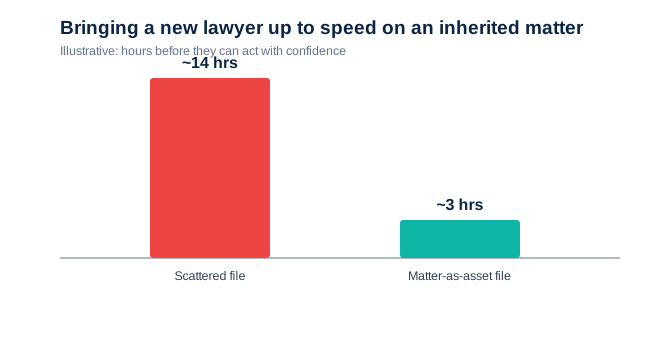
There is a single question that measures whether a matter file is an asset or a liability: if the responsible lawyer were unreachable tomorrow, could a competent colleague pick up the matter and act correctly by the afternoon? With a matter-as-asset file, the answer is yes — the chronology is clear, the key decisions are explained, the current posture is stated, and the deadlines are visible. With a scattered file, the answer is a nervous maybe, and the new lawyer spends most of a day reconstructing what should have been written down, all while a limitation date sits somewhere in the pile, unflagged.
A matter file that functions as capital tends to hold five things, kept current rather than assembled in a panic:
A clean chronology — what happened, when, in order, so anyone can follow the arc of the matter without narration.
The why behind key decisions — not just the settlement number, but the reasoning that produced it.
The current posture — where the matter stands today and what the next move is, in plain language.
Every deadline and limitation date — surfaced and owned, never buried in a document nobody reopens.
The client's stated goals — what they actually want out of this, in their words, so strategy stays anchored.
Turnover is inevitable; amnesia is optional
People will always leave. Partners retire, associates move, and the market pulls talent in every direction — no firm has ever solved that, and none will. What a firm can decide is whether a departure takes the knowledge with it. When lawyers file as they go — capturing the reasoning while it is fresh, not reconstructing it under deadline — the firm accumulates equity that outlasts any individual. When they file at the end, or never, the firm is renting its own institutional memory from whoever happens to still work there.
So the next time you look at a thin matter file, do not see a compliance gap. See a balance-sheet problem. Every matter carried in one person's head is an asset the firm does not actually own — it is on loan, and the loan can be called the day that person hands in their notice.
Look at your most valuable open matter and ask who else could run it tomorrow if they had to. More field notes on knowledge, records, and professional risk are published every week on the XNM blog.