The Most Expensive Words in Project Work: "I Think It's in Email"

There is a sentence you can hear in almost any project status meeting, and every single time someone says it, it quietly costs money. Someone asks where the approval is, or the latest drawing, or the decision from three weeks ago. And the answer comes back: "I think it's in email." Five words, said a thousand times a day across every industry — and they are among the most expensive words in project work.
They are expensive not because of the one document that is hard to find. They are expensive because of what the phrase reveals. "I think it's in email" is not a location; it is a confession about how the entire project stores its memory. By the end of this, you will hear that sentence differently — as an alarm, not a shrug.
Email is where decisions go to disappear
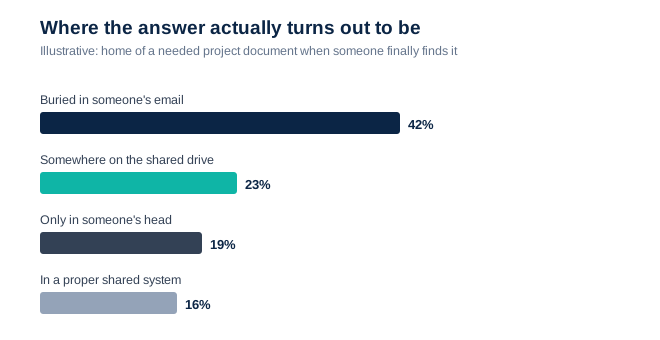
Think about what it actually means for a decision to live in email. It is personal — sitting in one person's inbox, invisible to everyone else. It is unstructured — filed under no project, no matter, no logical home, findable only by whoever remembers the right search term. And it is unshared — a decision that only one human can produce on demand. A decision in email is a decision the project does not really own. It owns a person who owns the decision, which is a very different and much more fragile thing.
Multiply that across hundreds of decisions on a live project and you get a memory made of individual inboxes — a memory that fragments a little more with every person who leaves, every mailbox that fills up, every thread that gets archived and forgotten. The project looks organized from the outside. Inside, its most important information is scattered across dozens of private accounts, and no one can see the whole picture.
The retrieval tax
Here is the cost that never shows up on a budget line. It is not the occasional email you cannot find; it is the retrieval tax you pay on every search. Picture a team of ten, each losing twenty minutes a day to "where is that" — hunting inboxes, asking colleagues, waiting for someone to forward a thread. That is a quiet, permanent full-time salary spent finding information the project already has. Nobody approved that hire. It just accumulates, twenty minutes at a time, invisible because it never arrives as a single bill.
The cure is a single question
You do not fix this by declaring email banned; people will always email. You fix it by changing what happens to a decision once it is made. Before you let an approval, a change, or a commitment live only in a thread, ask one question: if this person were unreachable tomorrow, could anyone else find this? If the honest answer is no, the decision does not belong only in email — it belongs somewhere the whole project can see, in a place that does not depend on one memory and one inbox.
So listen for the phrase. The next time someone says "I think it's in email," hear it for what it is: not a small inconvenience, but the sound of a project paying its retrieval tax out loud. The teams that get ahead of it are not the ones with the strictest email rules. They are the ones who made sure the answer to that one question is always yes.
Count how many times you hear "I think it's in email" this week - each one is a decision the project cannot see. More big-picture writing on information, trust, and the cost of lost records is published every week on the XNM blog.