The Pipeline's Real Asset Is Its Record: Why Integrity Lives in the File
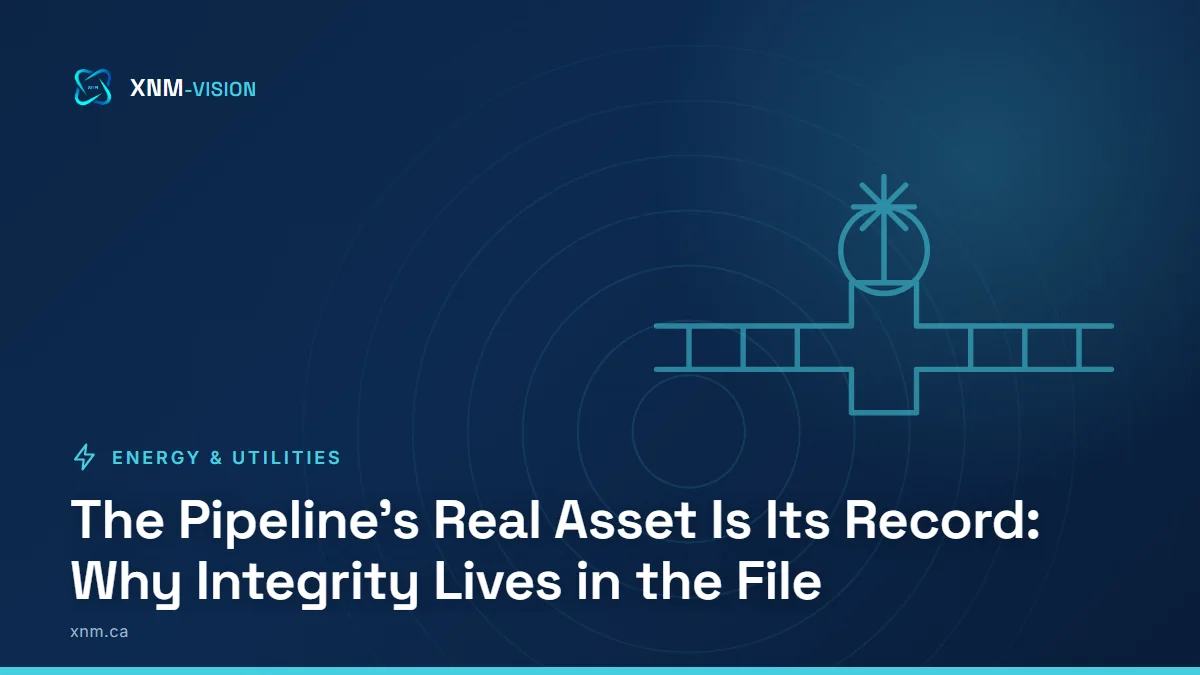
A buried pipeline is, to almost everyone, invisible. What stands between the public and the energy moving beneath their feet is not the steel alone but the record that proves the steel is sound: the inline inspections, the integrity digs, the coating surveys, the cathodic-protection readings, the repair histories and the pressure tests. An energy operator does not get to point at a pipe and say it is safe. It has to show the file. In a sector where the asset is out of sight and a single failure can become a national story, the integrity record is not paperwork around the business - it is the licence to operate.
That record is also enormous. A transmission operator manages thousands of kilometres of line, each segment with its own metallurgy, age, coating, soil, and inspection cadence - multiplied by every dig, every anomaly assessed, every repair sleeve installed, and every regulator filing that documents the decision. When that body of evidence is spread across engineering drives, inspection-vendor portals, field PDFs and the institutional memory of long-serving integrity engineers, the operator is exposed in exactly the places it can least afford: a regulator's audit, a landowner's question, an incident investigation, or the internal decision about which segment to dig next.
Recent context
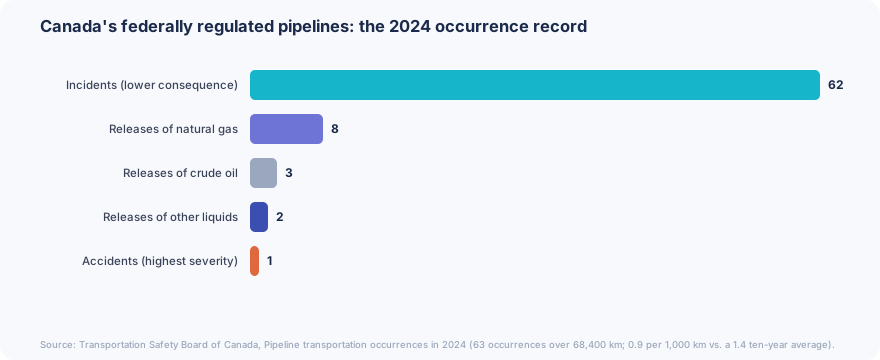
The safety numbers show what disciplined integrity management buys. The Transportation Safety Board of Canada reported that in 2024 there were 63 pipeline transportation occurrences across roughly 68,400 km of federally regulated line - a rate of 0.9 per 1,000 km, below the ten-year average of 1.4 - with just 13 occurrences involving a product release, the lowest number ever recorded, and no fatalities, continuing a trend since 2017. A safety record that strong is the visible output of an invisible discipline: knowing the condition of every segment and being able to prove it.
Integrity is a records problem before it is a steel problem
Pipeline integrity management is, at its core, an evidence system. The decision to dig a particular segment, to derate a line, to re-inspect on a tighter interval, or to leave an anomaly to grow under monitoring is only defensible if the data behind it is current, complete and retrievable. Regulators do not just want a safe pipe; they want to see the records that demonstrate the operator knew it was safe and acted on what it knew. The same file does double duty when something goes wrong. An incident investigation reconstructs the decision history segment by segment, and the operator's position is only as strong as the record it can produce on demand. A reassembled trail pulled from inboxes after an event is the weakest possible footing; a complete, time-stamped integrity file is the strongest. The record is what turns a defensible decision into a provable one.
How XNM helps
XNM helps pipeline and utility operators pull the integrity and asset record into one auditable command centre - inline-inspection results, dig and repair histories, cathodic-protection and coating data, pressure tests, and the regulatory filings and engineering decisions tied to each segment, organized by asset and kept current. Where it helps, XNM-Vision gives an integrity or regulatory lead a single line of sight across the system, so the next-dig decision rests on the full evidence rather than the most recent email, and so a regulator's request meets a complete file rather than a scramble. Because it stands up in days rather than the many months a records consolidation usually takes, the visibility arrives in time to inform the live integrity program, not the post-mortem.
Practical takeaways
Treat the integrity file as the asset. The pipe is only as safe as the operator can prove; an incomplete record undercuts the strongest physical program.
Tie inspection data to the decision it drove. An anomaly assessment matters most next to the dig-or-monitor decision it informed - keep them together, not in separate systems.
Keep the record regulator-ready by default. An audit or filing request will come; hold the integrity file in a state where the answer is already assembled.
Give the integrity team one system view. A program spanning thousands of kilometres needs a single current picture, not a portal per inspection vendor.
Capture the engineer's judgment, not just the data. When a veteran integrity engineer retires, the reasoning behind past decisions should stay with the operator, recorded against the segment.
FAQ
We already run a formal integrity management program. Isn't the record just an output of that?
The program defines what you do; the record is what proves you did it - and what you can produce when a regulator or an investigation asks. Programs that live in spreadsheets and vendor portals drift out of sync as segments are inspected and repaired. The value is a living record where inspection data, repairs and decisions update together, so the file always reflects the system as it is now.
Isn't this really an engineering question, not a records question?
The engineering is essential, but it only counts if it is documented and retrievable. The failures that hurt operators are rarely a lack of expertise; they are an inability to show, on demand, what was known and decided. Getting the record right is how the engineering becomes defensible.
The bottom line
Pipeline safety is built in steel and proven on paper. Canada's 2024 record - the fewest product releases ever, a rate well below the long-run average - is what disciplined, well-documented integrity management looks like from the outside. The operators who keep that record are the ones who can see every segment, prove its condition, and produce the file the moment anyone asks. You cannot demonstrate the safety of what you cannot document, and the record is how an operator earns the right to keep the energy moving.