The Funding Milestone Missed by a Signature

The money was approved. The work was done. The invoice was correct. And still, the payment sat — because one sign-off line was empty, and no one could quickly say whose name belonged on it.
This is one of the quietest, most expensive failures in project finance, and it has nothing to do with competence. A Nation running its own capital program had done everything right: the milestone was reached, the certification was written, the paperwork was clean. But the single approval that releases a milestone payment had been given verbally and confirmed in an email thread — not recorded anywhere the funder's process could see it. So the file looked, to an outside reviewer, unfinished. By the end of this you'll see why the fix wasn't another form; it was making one existing decision visible.
A milestone is a promise with a paper trail
Milestone funding works on a simple exchange: reach a defined stage, certify it, and a scheduled payment is released. It is a good model because it ties money to real progress instead of promises. But it has a hidden dependency — every release rests on a specific, attributable sign-off. Miss that, and the certification alone isn't enough. The reviewer on the other end isn't being difficult; they legitimately cannot release funds against a decision they can't locate.
When the payer and the payee are separate bodies — a Nation certifying work and an administrator issuing the payment instruction, for instance — the sign-off has to travel between them intact. An approval that everyone in the room understood is worthless to a person who wasn't in the room and can only see the file.
The gap is almost never the signature — it's where the signature lives
In nearly every delayed-milestone case, the approval was given. Someone said yes. The problem is that the yes was stored somewhere the record couldn't reach: a phone call, a hallway conversation, a reply buried three levels deep in a thread, a signature on a page that never got scanned back into the project file. When the release desk goes looking, they find the work but not the authorization, and the payment stalls on a technicality that is really a filing problem.
Here is where sign-offs typically disappear:
Verbal approvals. "Go ahead, it's fine" in a meeting — real, binding, and completely invisible to anyone who reads the file later.
Email-thread confirmations. The approval exists, but in one person's inbox, not on the record the funder actually reviews.
Wet signatures never digitized. A page was signed, then filed in a drawer, and the project record shows a blank.
Ambiguous authority. Two people could have signed, each assumed the other did, and the line stayed empty.
None of these are failures of diligence. They are failures of where a decision comes to rest.
The cost is measured in seasons, not days
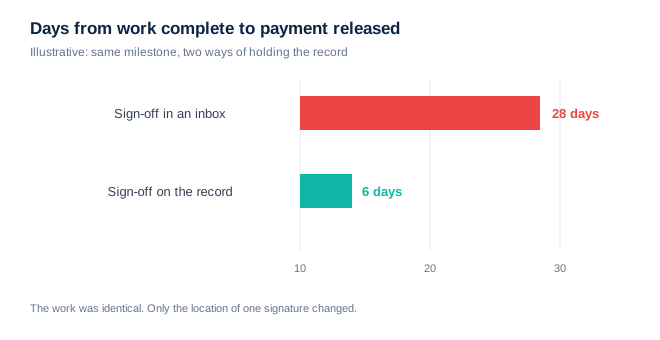
For an office pushing paper, a delayed release is an annoyance. For a capital project on a short construction season, it is a crew stood down, a contractor rescheduled, and a milestone that slips into next year. The illustrative case above shows the same work released in six days when the sign-off lived on the record — and dragging past four weeks when it lived in an inbox. The work never changed. Only the location of one signature did.
What to do before the next milestone
Decide, before the work starts, exactly who signs each milestone and where that sign-off gets recorded — not "in email," but on the project record itself, dated and attributable. Treat the authorization as part of the deliverable, not an afterthought that happens once everyone's already celebrating. The certification proves the work was done; the recorded sign-off proves someone with authority released it. A milestone needs both, in one place the funder can open without asking anyone a question.
A payment that waits on a missing signature is a records problem wearing a finance costume. For more field-tested ways to keep one trail everyone can trust, browse the XNM blog.