The File Is the Defence: Why a Law Firm's Matter Records Outlive Every Lawyer

A client calls about a file your firm closed six years ago. The lawyer who ran it has retired, the associate who did the drafting has moved to another firm, and the paralegal who kept the calendar left in between. What remains is the matter file - and whether it is complete, current, and findable decides how the next hour goes. If the retainer, the advice given, the instructions received, and the deadlines diarized are all there, the call is routine. If they are scattered across a departed lawyer's inbox, a shared drive, and a banker's box in storage, the firm is now reconstructing its own memory under pressure. For a law firm or notary practice, the matter file is not a byproduct of the work. When something goes wrong, the file is the defence.
Every practice runs on matters, and every matter is a record before it is anything else: the engagement letter, the client's instructions, the advice and the reasoning behind it, the limitation dates, the correspondence, the drafts and executed documents, the disbursements, and the closing. That record has to serve three masters that rarely arrive on schedule. It has to survive turnover, so a matter can be picked up cleanly when the originating lawyer is gone. It has to satisfy a law-society or regulator audit, which asks not what you remember but what you can produce. And it has to stand as the firm's defence when a malpractice claim surfaces - often years after the file was thought to be finished. A thin or disorganized file fails all three at once.
Recent context
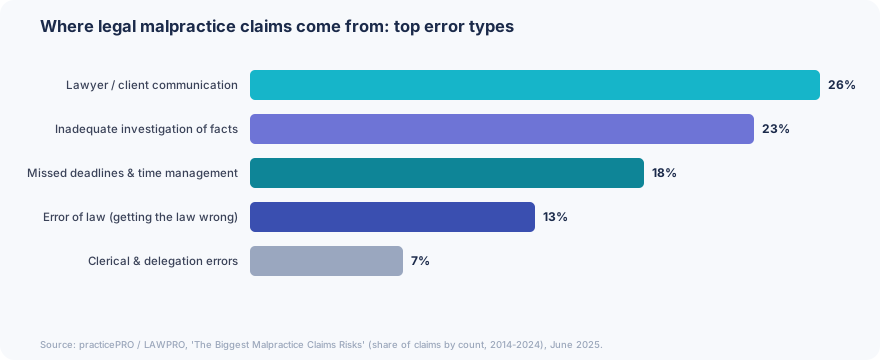
The data on where claims come from is unambiguous. practicePRO and LAWPRO's 2025 review of Ontario claims found that over the last decade the leading causes of malpractice claims were not exotic errors of legal judgment but ordinary breakdowns in the record: lawyer/client communication problems drove more than a quarter of claims by count, inadequate investigation of the facts about 23%, and missed deadlines and time management roughly 18%. Getting the law wrong ranked only fourth. LAWPRO also notes these matters are difficult to defend successfully where the lawyer has not documented instructions and advice with sufficient notes - which is to say the claim is often won or lost on the file, not the facts.
Why a matter file is really a liability record
Read the claims data closely and a theme emerges: the most common failures are failures of documentation, not of lawyering. A communication claim usually turns on a dispute over what was said and when - which is decided by whether the advice was confirmed in writing and kept in the file. A missed-deadline claim is a diary and tickler failure, not an error of law. Inadequate investigation leaves the thinnest trail of all: the record simply does not show the question that should have been asked. Because professional limitation periods are long, the file has to hold up years later, when memories have faded and the people involved have moved on. A reconstructed file assembled from inboxes after a demand letter is the weakest possible position; a complete, contemporaneous, time-stamped matter file is the strongest defence a firm can bring. The same discipline that protects against a claim also carries the firm through a law-society spot audit and through the ordinary handoff when a partner retires or a matter is reassigned.
How XNM helps
XNM helps a firm keep the whole matter record in one auditable place - engagement terms, instructions, advice confirmations, limitation dates, correspondence, drafts and executed documents, and the disbursements and closing that go with them - organized by matter and kept current as the work moves. Where it helps, the XNM-Vision platform gives a managing partner or director of practice management a single line of sight across matters, so a file can be handed off cleanly, an audit request answered from what is already on record, and a late claim met with a complete, time-stamped file rather than a scramble through old inboxes. The point is not another repository to search; it is one governed record per matter that the active work, a future audit, and a possible claim all depend on - and because it stands up in days rather than the many months a records overhaul usually takes, the firm gets that protection while the matters are still open, not after.
Practical takeaways
Treat the matter file as the deliverable it will be judged as. When a claim or audit arrives, no one grades the brilliance you remember - they read the file you can produce, so build it as you go.
Confirm advice and instructions in writing, every time. Communication drives the largest share of claims and turns on documentation; a confirming note in the file is the cheapest liability insurance a lawyer can buy.
Make limitation dates a system, not a memory. Missed-deadline claims are calendar failures - keep every limitation and reminder tied to the matter, not to the one person who knows it.
Assume the file must survive the lawyer. Build each matter so it can be picked up cleanly when the originating lawyer retires or leaves; institutional memory should stay with the firm.
Keep every closed file audit-ready and claim-ready. Limitation periods are long; a matter thought finished can reopen years later, so close files into a state where the record is already complete.
FAQ
We already have a document management system. Isn't the file already handled?
Storage is not the same as a defensible record. A document management system tells you where files live; it does not guarantee that the advice was confirmed, the instructions captured, the limitation diarized, and the whole matter kept complete as it moved. The failures that drive claims happen in those gaps - the missing confirming letter, the deadline that lived in one head. The value is in a governed, current record per matter, not just a place to put documents.
How long do we really need to keep a matter file intact?
Longer than most firms plan for. Professional limitation and discoverability rules mean a claim can arrive well after a matter is closed and after retention minimums have technically passed, and the firm's defence is only as good as the file it can still produce. The safe posture is to keep each matter complete, organized, and retrievable for as long as any exposure could conceivably run - and to know exactly what you hold.
The bottom line
A malpractice claim is, most often, an argument about the record - what was said, what was checked, what deadline was kept. The firms that win those arguments are not the ones with the best memories; they are the ones whose matter files were complete and defensible before anyone needed them. The file has to survive the lawyer who opened it, the audit no one scheduled, and the claim that arrives years late. Build it to survive all three, because when the defence is needed, the file is the defence.