The Easement Everyone Forgot

The deal was done. The lender was ready, the lawyers were drafting, the build was designed down to the parking ratio. Then a routine title review turned up eleven words registered against the land in 1986 — a utility easement running diagonally beneath the very spot where the tower's foundation was meant to go. Nobody on the development team had ever seen it. It had been a matter of public record for thirty-eight years.
What followed was not a catastrophe in the cinematic sense. No one was hurt, nothing collapsed. It was quieter and more expensive than that: a closing pushed, a land loan accruing interest on a parcel that could not yet be built, a design team reopening a set everyone thought was finished, and a utility company in no particular hurry to discuss relocating its right-of-way. The easement had not appeared. It had simply, finally, been read.
A matter of record, just not their record
This is the trap that catches sophisticated developers, not careless ones. The legal history of a piece of land does not live in one place. It is scattered across the title register, decades of survey plans, the original subdivision agreement, municipal engineering files, and the memories of people who have long since retired. A development team builds its working file out of whatever pieces it happens to gather during due diligence. The easement was real, recorded, and discoverable the entire time. It was simply never in the file the team was actually working from.
The danger of an encumbrance like this is that it stays invisible until the exact moment it is most expensive. During design, it costs nothing to know about — you simply draw around it. During financing, the lender's lawyers go looking, because their job is to find the thing that turns their collateral into a problem. By the time it surfaces at closing, the cost of the easement is no longer the easement. It is the redesign, the delay, the carrying cost, and the lost negotiating leverage, all arriving at once.
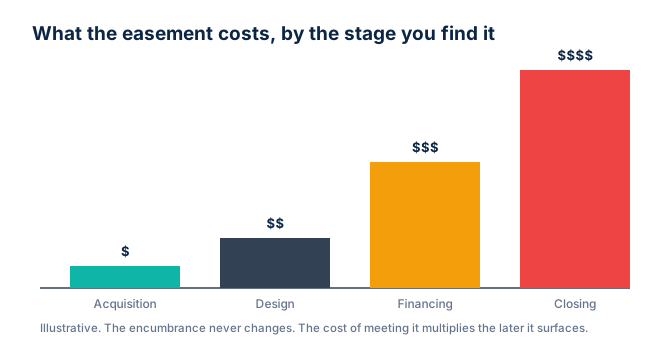
Encumbrances are cheap to find early and ruinous to find late
The teams that do not get ambushed are not luckier. They treat the land's legal history as a living record they assemble at acquisition and never stop maintaining. Before a dollar is committed, they pull everything — title, every registered instrument, every survey, the subdivision and servicing agreements — and they reconcile it against the development concept. Every easement, right-of-way, covenant and lien gets logged, located on the plan, and handed to someone whose job is to clear it or design around it.
Build an encumbrance register at acquisition. Pull every registered instrument against title and list it. The goal is a single page that answers, plainly, what binds this land.
Put each encumbrance on the drawing. An easement you can see on the site plan is an easement you design around. One that lives only inside a legal description is one you forget.
Give every encumbrance an owner and a status. Known, located, cleared, designing-around. An item with no owner is the item that surfaces at closing.
Re-run the title review before you commit, not after. The lender will. Finding what they find, before they find it, is the entire game.
The easement everyone forgot was not a failure of intelligence. It was a failure of filing — of a record that existed in the world but not in the room where decisions were being made. The fix is not to be smarter. It is to make the land's full legal history the first thing you assemble and the last thing you let go stale.
Pick one parcel in your pipeline this week and ask a simple question: can you produce, from your own file, a complete list of everything registered against it, each item located on the plan, each with an owner? If you cannot, the gap is not theoretical. It is the easement you have not found yet.
We take apart a different quiet, expensive records failure every week in our records and accountability series. They almost always share this shape: the information existed, it was just not where the decision was being made. A system like XNM-VISION exists to put the land's full record in the room — but the discipline of pulling it early matters more than any tool.