One Chart: The Real Timeline of a Change Order

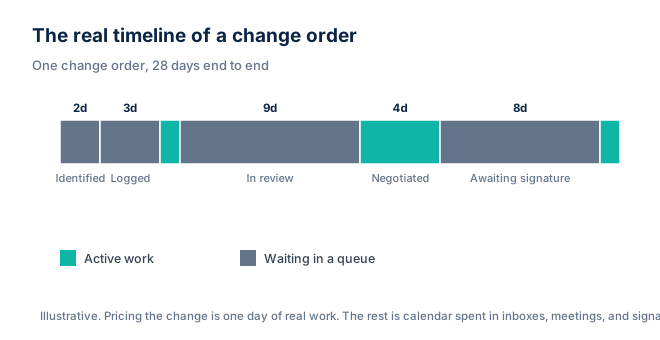
A change order on a construction project is, on paper, a simple thing: the work changed, so the price and schedule change, and everyone signs. In practice, the average change order spends most of its life doing nothing — sitting in an inbox, waiting for a meeting, parked behind a signature — while the crew in the field keeps building against a number nobody has agreed to yet. The chart below is where the days actually go.
Ask a project team how long a change order takes and they will tell you the number on the contract: ten days, fourteen days. Ask them to trace one real change order from the moment the condition was discovered to the moment the last signature landed, and the number is usually two to three times longer. The distance between those two numbers is where disputes are born.
The work is a day; the waiting is everything else
Look at where the time concentrates. Actually pricing the change — the part that takes skill and judgment — is often a single day of real effort. Everything around it is queue: the days the request sits before it is logged, the wait for the next site meeting to raise it, the stretch while it climbs an approval chain, the final pause for a signature from someone who is travelling. None of that is work. All of it is calendar.
This matters because a change order is not free while it waits. The field does not stop. Crews either proceed at risk on an unapproved change — and now the company is exposed if the price is later disputed — or they stop and the schedule slips. Meanwhile the conditions that drove the original price keep moving: material costs, crew availability, the weather window. A change priced in week one and signed in week six is often no longer correctly priced at all.
Make the waiting visible
You cannot speed up a process you cannot see. The single most effective fix is also the least glamorous: a change-order log that tracks each change through its stages, with a status, an owner, and a date for every step. The instant a change has been in review for nine days, the log makes the bottleneck impossible to ignore — and bottlenecks that are visible get cleared, while bottlenecks buried in email do not.
Log the change the day it is identified, not the day it is priced. The clock that matters starts at discovery. If logging waits for pricing, you have already lost the most invisible days.
Record a status and an owner at every stage. Awaiting pricing — Sam. In owner review — since the 4th. A change with no current owner is a change that has stalled.
Track the dates, then look at the gaps. The gaps between stage dates are your real process. They tell you exactly where to push.
Tie the signed change back to its contract value. So the project's number is always the agreed number, not the optimistic one from the kickoff.
The lesson of the timeline is not that change orders are too slow. It is that almost all of the slowness lives in waiting that no one is watching. Watch it — put each change on a log with a status and a date — and the days that used to vanish into inboxes become days you can actually manage.
This chart grew out of a story we told earlier — the change order that got priced twice because the paper trail forked — and it pairs with the simple log that prevents it. Both live in our records and accountability series.