Good Records Are Really Good Decisions

We tell ourselves we keep records to remember what we did. That is the small reason. The real reason is stranger and more important: a record is how a decision survives the people who made it. The choice made in a room on a Tuesday has to go on being defended, repeated, and — when it turns out wrong — intelligently reversed, by people who were not in the room and never will be. Without a record, the decision does not outlive the meeting.
Consider what an undocumented decision actually becomes. Six months later, someone asks why the project went with the more expensive foundation system, or why a clause was struck from the contract, or why the board approved a budget line nobody now defends. The answer comes back as a shrug and a sentence: I think we decided that because... That sentence is the sound of a decision that did not survive. The organization is now re-litigating something it already settled, because the settlement was never written down.
A decision is not the moment; it is the rationale
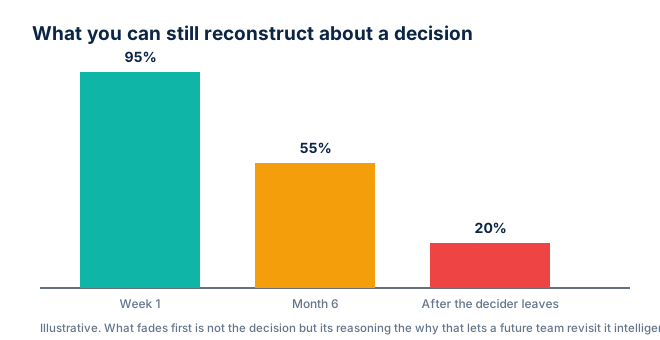
Here is the part most teams get wrong: they think the record of a decision is the decision itself — the what. We approved X is the easy part, and the least useful. What an organization actually needs later is the why: what problem this solved, what we knew at the time, what alternatives we weighed, and what we deliberately rejected. A decision without its reasoning cannot be revisited intelligently. When conditions change — and they always do — the team needs to know whether the original logic still holds, and you cannot test logic that was never recorded.
This is why the best decision records are short but specific. Five lines will do: what we decided, why, who decided it, what we knew that mattered, and what we considered and ruled out. That tiny artifact does something remarkable. It lets a future team stand where the original team stood, see what they saw, and either trust the decision or overturn it on purpose rather than by accident.
Records are how an organization thinks over time
Scale this up and something larger comes into view. An organization that documents its decisions can act as a single mind across years and across turnover. It can learn, because it can look back at what it believed and check it against what happened. An organization that does not is condemned to a kind of permanent amnesia — re-deciding the same questions, repeating the same mistakes, and treating every departure as a small fire because the person leaving was the only copy of the reasoning.
The reversibility point is worth sitting with. A documented decision can be safely undone, because you can see the assumptions it rested on and check whether they still hold. An undocumented decision cannot really be undone — only forgotten and re-stumbled-into. Good records do not make an organization rigid. They make it safely changeable, which is the opposite.
So the next time a real decision gets made — the kind someone will ask about in a year — spend the five lines. Write what you chose, and write why. Not for the audit, not for the file, but for the version of your organization that has to live with the choice after everyone who made it has moved on.
This is, in the end, the whole argument behind the work we do: that the record is not the bureaucracy around a decision but the substance of it. It is the problem we built XNM-VISION to solve. We make the case from a different angle every week in our records and accountability series.