Field Notes: Non-Profits and the Grant-Reporting Squeeze

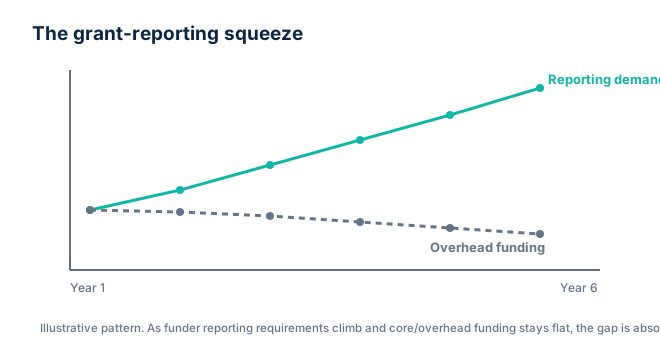
Here is the quiet math that runs most non-profits today: the reporting their funders demand goes up every year, the funding for the people who do the reporting goes down, and the gap between the two is filled by one tired program manager at nine at night. That gap has a name in the sector. It is the grant-reporting squeeze, and underneath, it is a records problem.
From the outside, a grant looks like money for a mission. From the inside, it is a contract with a documentation schedule attached. A mid-sized non-profit might run six, ten, fifteen grants at once, each with its own reporting template, its own budget categories, its own cycle, its own definition of an allowable expense. The mission is the same across all of them. The paperwork is not — and the paperwork is what keeps the money coming.
Same expense, reported three different ways
The specific cruelty of multi-funder work is that a single, real cost has to be sliced and re-sliced to fit each funder's frame. The program coordinator's salary is one expense in the real world. In the file, it is forty percent against one grant's personnel line, thirty percent against another's program-delivery line, and the rest unfunded — and each funder wants it proven their way, on their schedule. Do that across a dozen grants and the reporting burden is not additive. It compounds.
This is why the squeeze lands so hard on small teams. The organizations doing this work are staffed by people who came for the mission, not for the chart of accounts. Records discipline is rarely anyone's actual job; it is the thing that happens after the real work, if there is time, which there is not. And non-profit turnover runs high, so the institutional memory of how last year's report was assembled tends to walk out the door right before this year's is due.
Capture once, report many
The non-profits that escape the squeeze do not work harder at reporting. They move the work earlier, into the program itself. The principle is capture-once: record each cost and each outcome a single time, in a structure that can be sliced for any funder, instead of reconstructing it per report at year-end.
Keep one chart of accounts, mapped to every funder. Record the expense once against a master category, then map that category to each grant's required line. The mapping is built once; reporting becomes a filter, not a rewrite.
Collect outcomes as part of delivery. The attendance sheet, the intake form, the outcome note captured the day the service happens is evidence. The same number reconstructed in March is a guess.
Tie every cost to its grant as it is incurred. Coding a receipt the day it arrives takes seconds. Matching a year of receipts to grants under a deadline takes a week and misses things.
Keep a running reporting file per grant. So that on reporting day there is nothing to assemble — only something to submit.
Doing more with less is the permanent condition of the sector, and no software changes that. But a great deal of the less is spent reconstructing records that could have been captured once, in the moment, for free. The squeeze is real. A large part of it is also self-inflicted by year-end scrambles that better records would simply prevent.
If your organization runs more than three grants, the test is quick and uncomfortable: pick one and try to assemble its next report today, from the file alone. Whatever you cannot find without asking someone to remember is the part of the squeeze you can actually fix.
We write a Field Note like this from a different world every week — last week the document trail that closes a developer's deal, soon the engagement file that protects an accounting firm. They are the same story told in different rooms. Read more across our Field Notes series.