The Deficiency-to-Done Checklist

A deficiency is not closed when the work is done. It is closed when someone with the authority to accept it has seen it, signed it, and filed the proof. Most punch lists never reach that last step - which is exactly why the same items keep coming back.
Every trade knows the ritual: walk the site, list what is wrong, fix it, move on. What almost no one runs cleanly is the closing half - the part that makes a fixed item stay fixed. By the end of this you will have a four-step test for whether a deficiency is actually done, or just quiet.
The difference between fixed and closed
A deficiency has two lives. In the first, the work gets corrected - the paint touched up, the door adjusted, the missing gasket installed. In the second, someone verifies the correction, records who did it and when, and gets sign-off from the party who raised it. Skip the second life and you have a fixed item with no proof it was fixed. When it fails again - or when the owner asks - you are relitigating from memory.
This is why punch lists reopen. Not because the trades did not do the work, but because closure was verbal. 'Yeah, we handled that' is not a closed deficiency. It is a claim. And on a project with three hundred items across a dozen trades, claims do not survive contact with a warranty dispute or a final inspection.
The four gates every deficiency has to pass
Treat closure as a gate, not a checkbox. An item is done only when it clears all four:
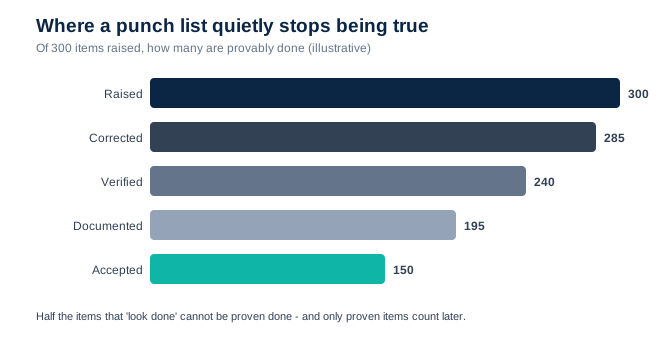
Corrected - the actual work is complete, not scheduled or promised
Verified - someone other than the person who fixed it confirmed the fix on site
Documented - a photo, a date, and the names of who did the work and who checked it
Accepted - sign-off from the party who raised the deficiency, closing the loop
Miss any one and the item is still open, no matter what the schedule says. A deficiency that is corrected but not accepted is a dispute waiting for a trigger.
Why the last gate is the one that saves you
Acceptance is the gate everyone skips and the only one that protects you later. It is the difference between 'we think that got fixed' and 'the owner's rep signed off on it on the fourteenth.' At final inspection, in a warranty claim, or in the argument over releasing holdback, only the accepted items count. The rest are back on the table.
Track status by gate, not by a single open/closed flag
Require photo evidence before an item can move to accepted
Name a single closer per item - the person accountable for the sign-off
Never release holdback against items that have not cleared all four gates
What to do tomorrow morning
Pull your current punch list and sort it by the four gates. Count how many items are genuinely accepted versus merely corrected. The gap between those two numbers is your exposure - the items everyone believes are done that cannot be proven done. Close that gap now, while the trades are still on site and the memories are fresh, because every one of those items gets more expensive the day the project team demobilizes.
A punch list that reopens is the same failure as an as-built that never got updated - work that happened but was never recorded. We keep following that threadthrough the field notes on the blog. Run every deficiency through the four gates, and 'done' stops being a claim and becomes something you can prove.