One Chart: The Lifecycle of a Single Drawing

A single structural drawing can pass through nine hands and six revisions between the day it is issued for construction and the day it is filed as an as-built. Most of them never make that last trip accurately.
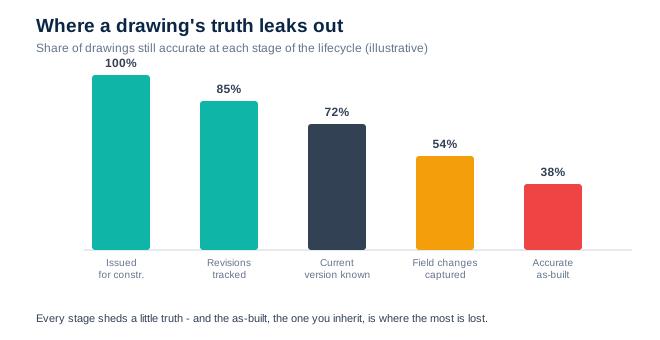
Follow one drawing through a project and you learn more about document control than any policy could teach you. It starts clean, gets marked up, gets superseded, and - if you are lucky - ends as an accurate record of what was actually built. By the end of this you will see exactly where in that journey the truth quietly goes missing.
Issued for construction is the beginning, not the end
The moment a drawing is stamped 'issued for construction,' it starts drifting from reality. The field hits a conflict - a pipe where a beam should be - and the fix happens on paper, on site, in a markup nobody uploads. A revision is issued. Then another. Each version is correct for a moment and wrong the next. The drawing's job is to stay ahead of the building; more often the building gets ahead of the drawing.
The critical, boring truth is that a drawing's value depends entirely on whether you know which version is current. Six revisions are an asset if they are tracked and a landmine if they are not. The crew building off revision three while revision five sits in an inbox is the origin story of a very expensive mistake.
The as-built is where lifecycles go to die
The last stage - turning the final marked-up set into an accurate as-built record - is the one most projects fudge. The trades are gone, the deadline has passed, and updating drawings to reflect a dozen field changes feels like homework after the exam. So the as-builts get stamped from the last issued set, not from what was actually built. The record looks complete. It just is not true. And the person who inherits that building - the one who cuts into a wall in ten years expecting a drawing to be right - pays for the shortcut.
Every drawing carries a version, a date, and a status anyone can read at a glance
Field changes are captured as they happen, not reconstructed at closeout
One controlled source of truth, so nobody builds off a superseded set
As-builts reflect what was built, verified against field records - not the last issued set
What to do tomorrow morning
Pick one drawing from a project you finished last year and ask a single question: does the as-built on file match what is actually in the building? If you cannot answer with confidence, the lifecycle broke somewhere between issued-for-construction and the archive - and every drawing on that project probably broke in the same place. Find the break once, and you have found it for the whole set.
A drawing that quietly stops being true is the same failure as a deficiency marked closed that never was - a record that outran reality. We keep tracing that threadacross the field notes on the blog. Control the version at every step, and the as-built becomes a record you would stake a renovation on.