Field Notes: Public Works and the Shovel-Ready Myth

When the grant money appears, the call goes out for 'shovel-ready' projects. Half the projects that raise their hand are not ready to dig. They are ready to hope.
For a public works department, the gap between shovel-ready and shovel-hopeful is the difference between spending a funding window and forfeiting it. The money is real, the deadline is real, and the thing that decides whether you can use it is not the shovel. By the end of this you will know the five documents that separate a fundable project from a wish.
Shovel-ready is a paperwork state, not a construction state
'Shovel-ready' sounds like it is about the physical work - crews staged, equipment booked. It is not. It is about whether the decisions are made and documented: design finalized, land secured, permits in hand, budget approved, procurement path cleared. A project is shovel-ready when a stranger could pick up the file and know exactly what to build, on whose land, with whose money, under which approvals - without asking a single person a question.
Which is why the myth is so expensive. Departments describe projects as ready based on how close they feel, not on what is actually documented. The design is 'basically done.' The easement is 'being worked out.' The budget is 'in the plan.' None of those survive a funder's due diligence, and the funding window does not wait for you to catch up.
The five documents that make it real
Final design - stamped and complete, not 60% and still evolving
Land and access secured - title, easements, and rights-of-way documented and signed
Permits and approvals - environmental, regulatory, and municipal, in hand or with a firm date
Approved budget with contingency - a council-approved number, not a planning estimate
A cleared procurement path - the route to award defined before the money lands
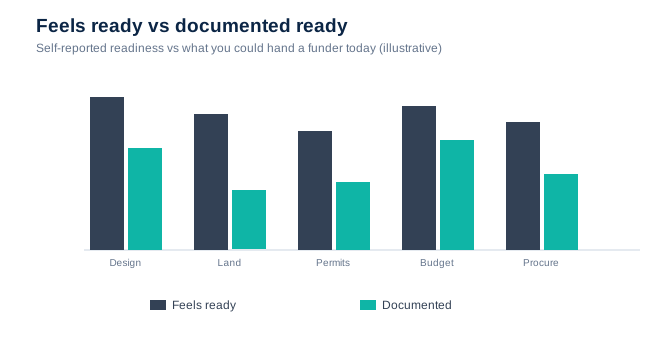
The window is shorter than the work
Grant windows are brutal about timing. Money often has to be committed - sometimes spent - inside a fiscal year. A project that needs six months of design and permitting before it can break ground cannot absorb a ninety-day window, no matter how badly the community needs it. The readiness work has to be done before the money is announced, not after. Departments that win the funding game keep a standing shelf of genuinely documented projects, ready to submit the day the call goes out.
Keep a live shelf of documented projects, not a wish list
Track each project against the five documents, updated quarterly
Treat 'being worked out' as 'not ready' - because a funder will
Log the date each document is complete, so readiness is provable, not asserted
What to do tomorrow morning
Take your top three capital priorities and score each against the five documents - not on how ready they feel, but on what you could hand a funder today. Every 'in progress' is a task with a deadline you set now, or a forfeited grant you explain later. The next funding window is coming. Whether you can actually use it is being decided this quarter, in a filing cabinet, long before anyone picks up a shovel.
Readiness that lives in someone's confidence instead of the file is the same trap as a budget nobody reconciled - it looks fine until the day it is tested. We keep pulling that threadacross the field notes on the blog. Build readiness as documentation, not optimism, and the next funding call becomes an opportunity instead of a scramble.